
Roofing squares and cost
Free roofing cost calculator
Enter measured roof area or calculate it from a building footprint and pitch factor, then add waste, materials and either square-based or hourly labor.
Free, no sign-up, and the entered values stay in your browser.
How to use the roofing cost calculator
Enter the roof area—or calculate it from building dimensions and pitch—then set waste, materials and labor. The result is a working job-cost estimate, not a site inspection or a binding roof replacement quote.
Enter measured area or building dimensions
Use the actual roof surface area, or choose the building-dimensions method and enter length and width. The dimensions method applies the selected roof pitch. Do not use the combined floor area of a multi-story home as its footprint.
Set pitch and material allowance
For the dimensions method, select the measured rise over a 12-unit run. Set a separate waste allowance for the purchase quantity; measured area and ordering allowance are not the same thing.
Enter material and labor costs
Enter material and labor amounts per roofing square, where one square equals 100 ft², or switch labor to hours and hourly cost. In metric mode, use the units shown beside each field. Do not add a full labor charge to a material rate that already includes installation.
Review the complete project scope
Check adjusted area, roofing squares, materials and labor. Price tear-off, disposal, decking repairs, flashing, access equipment, permits, overhead and profit separately if they are not included in your inputs.
How much does a roof replacement cost?
A useful roof budget begins with a measured surface area and a written scope. A 1,700 ft² roof and a 1,700 ft² house are not necessarily the same size: slope, overhangs, garages and the number of floors change the area to be covered. Material grade, removal work, access and local labor prices then determine the amount of the quote.
For dated national context, GAF cites the 2025 U.S. Roof Report at an average roof replacement cost of $17,631. That figure covers a mix of projects and is not a price for a particular 1,700 ft² home. Ask for current local quotes before making a purchase decision.
The tables below use explicit budgeting scenarios, not a current market-price survey. They demonstrate how each part changes a quote. Replace every example rate with the supplier and contractor figures applicable to your property.
Roofing squares = measured roof area ÷ 100
Installed base budget = roof area × installed unit price
Installed base budget = roof area × installed unit price
At an assumed installed price of $6–$9/ft², a 1,700 ft² roof has a base budget of $10,200–$15,300. Whether removal, trim, repairs and permits are included must be stated before that range can be called a complete project estimate.
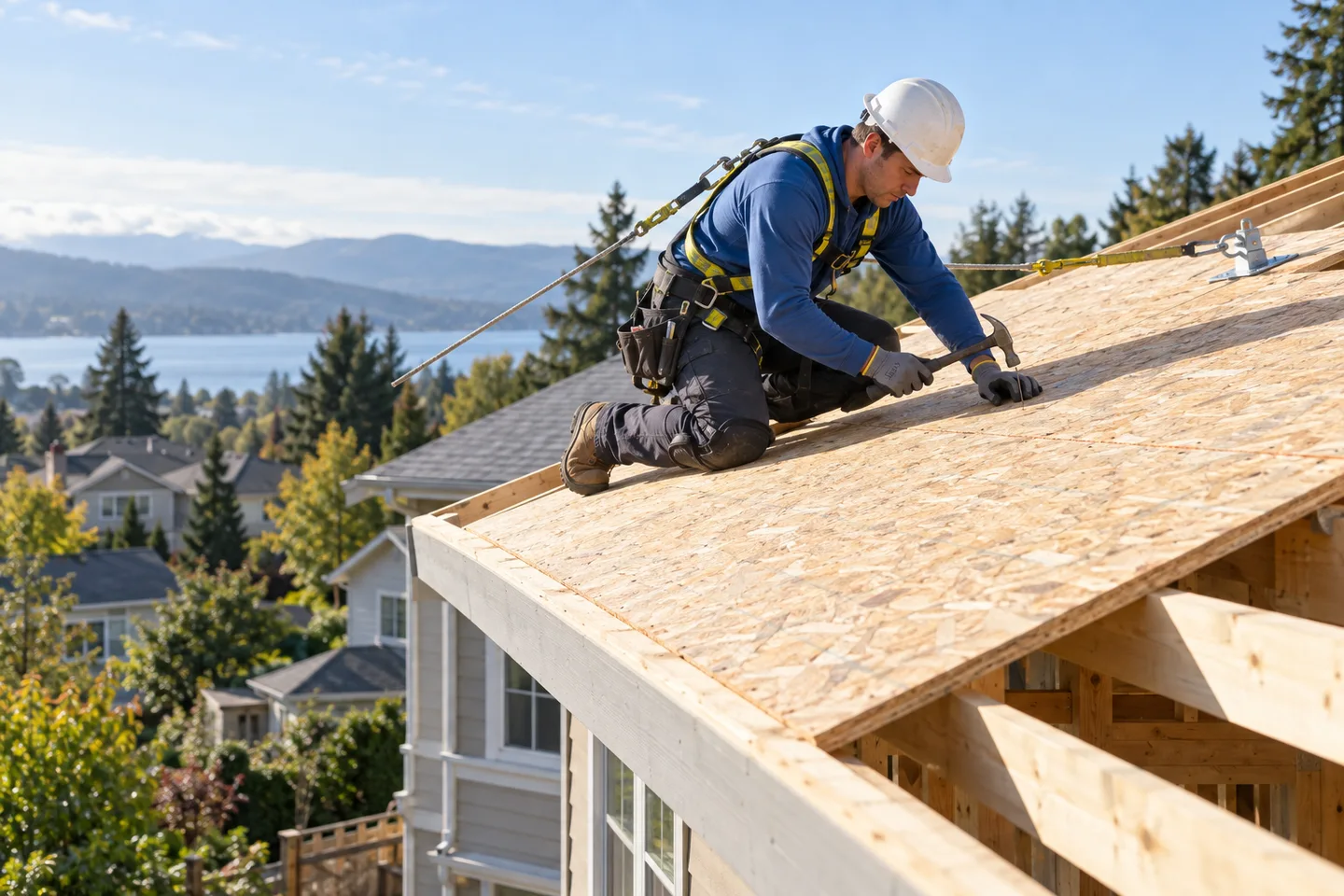
Compare roof replacement materials
Roof coverings differ in appearance, weight, installation method and maintenance needs. Compare complete roof systems, not just bundles or panels. The purchase price of a covering alone leaves out the underlayment, fasteners, edge details and labor needed to install it.
| Roof covering | Example installed rate / ft² | 1,700 ft² calculation |
|---|---|---|
| Asphalt shingles | $6–$9 | $10,200–$15,300 |
| Metal roofing | $9–$20 | $15,300–$34,000 |
| Concrete or clay tile | $11–$22 | $18,700–$37,400 |
| Wood shakes or shingles | $10–$16 | $17,000–$27,200 |
| Natural slate | $22–$36 | $37,400–$61,200 |
Illustrative installed-price inputs only. These are not supplier offers, national averages or a guarantee of what a contractor will charge. Structural work, tear-off and unusual access are not assumed to be included.
Asphalt shingles: basic, architectural and premium
Asphalt is a practical comparison point when requesting bids because contractors commonly supply several grades. Ask for the exact product, color, wind requirements, accessories and warranty terms on each estimate.
- Three-tab: a relatively flat, repetitive profile. Check availability and whether it is appropriate for the roof and local wind requirements.
- Architectural: laminated layers produce a thicker, dimensional appearance. Installation details and warranty coverage still depend on the selected system.
- Premium laminates: more elaborate shapes and finishes can increase material and handling costs. Compare the complete specification instead of treating a longer warranty label as a guaranteed service life.
- Recycled-content options: request actual recycled-content documentation and verify local rebate eligibility; neither an environmental claim nor a rebate should be assumed.
Metal roofing: panels, shingles and standing seams
Metal can provide a long service life when the assembly is appropriate and installed correctly. Gauge, coating, metal type, fastening method, trim and panel fabrication affect the quote.
- Corrugated or exposed-fastener panels: compare the panel price together with fasteners, sealants and ongoing inspection requirements.
- Metal shingles: individual pieces provide a shingle-like appearance, with their own detailing and labor requirements.
- Standing-seam panels: raised seams and concealed attachments form a different system; price transitions, penetrations and custom fabrication explicitly.
Ask whether the metal quote includes removing the old covering, disposal and any deck preparation. A material-only metal price cannot be compared directly with an all-inclusive asphalt quote.
Concrete and clay tiles
Tiles create a distinctive profile and require the correct support and attachment. Concrete is an alternative to clay, but do not assume it is lightweight. Have the roof structure checked for the actual product load.
- Concrete tile: compare the tile specification, finish, battens and installation method.
- Clay tile: shape, firing, finish and matching accessories influence cost. Fragile or aged pieces need careful handling.
Long-lived tiles do not make the underlying assembly maintenance-free. Underlayment, flashings and broken units still require inspection and may need work earlier than the covering itself.
Wood shakes and wood shingles
Wood roofing may use cedar or other suitable species. Shakes have a more textured split appearance; shingles are sawn for a more uniform finish. Product grade, treatment, exposure and installation detail matter as much as appearance.
Discuss fire requirements, ventilation, moisture exposure and a product-specific maintenance plan before choosing wood. Clear debris and inspect for decay; apply cleaners or treatments only where the manufacturer recommends them. A universal annual sealant recommendation is not appropriate for every product.
Natural slate
Slate combines a distinctive finish with the possibility of a very long service life. Its weight, breakage allowance and specialist installation can raise both material and labor costs. Confirm structural capacity before ordering, and price any strengthening separately.
A durable covering does not remove the need to maintain flashings, fasteners and transitions. Use a roofer experienced with slate, and keep compatible spare pieces for future repairs.
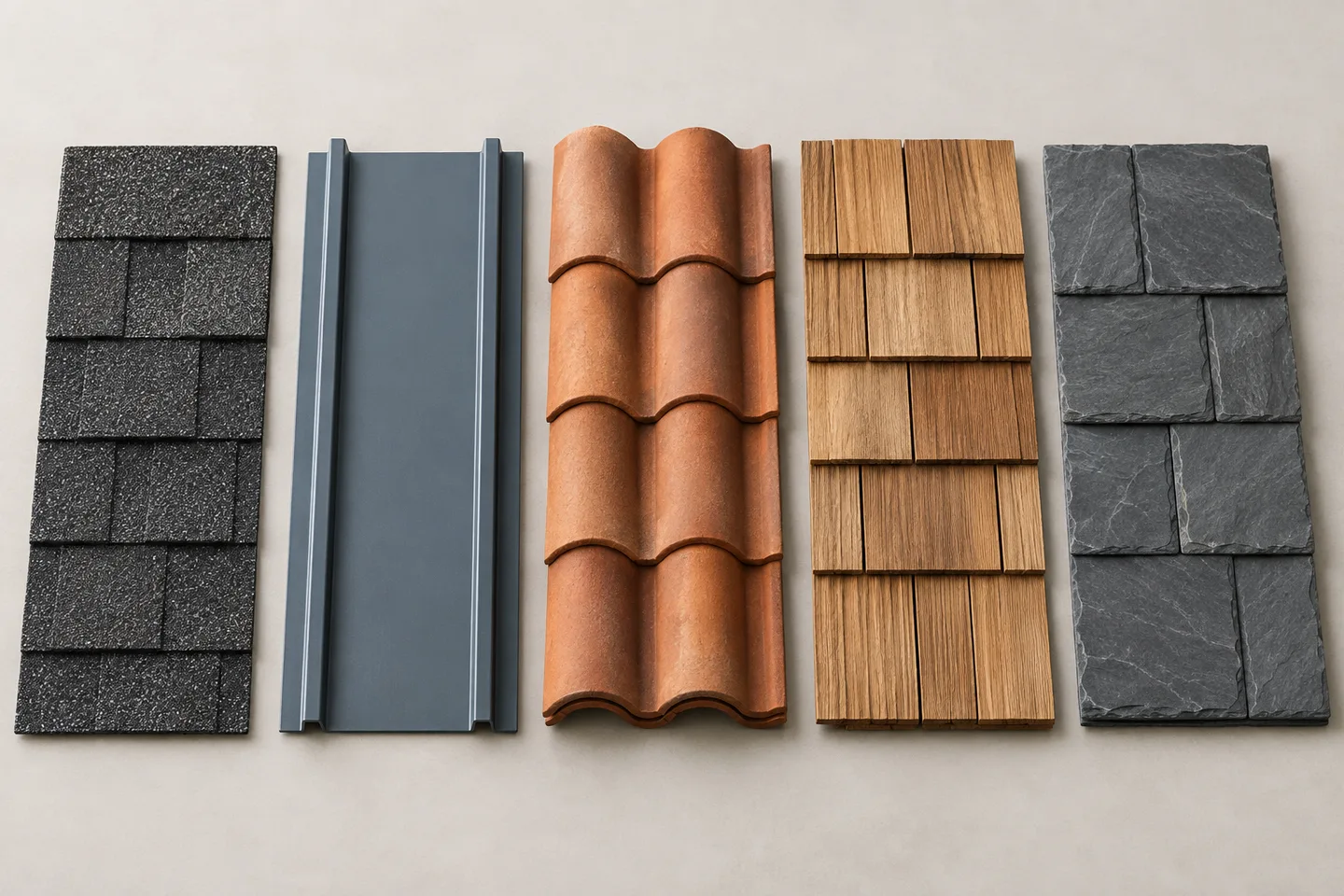
Roofing labor: removal, installation and access
Separate work that takes the old roof off from work that puts the new roof on. Crew hours also include setup, protection, loading, carrying, cleanup and inspections. A labor allowance based only on the time spent attaching shingles can be misleading.
| Labor item | Illustrative rate / ft² | 1,700 ft² example |
|---|---|---|
| Remove a straightforward lightweight covering | $1.50–$3.00 | $2,550–$5,100 |
| Remove heavy or difficult tile/slate | $3.00–$5.00 | $5,100–$8,500 |
| Install a straightforward new covering | $3.00–$4.00 | $5,100–$6,800 |
| Install a more complex or steep assembly | $4.50–$7.00 | $7,650–$11,900 |
For example, $1.50/ft² for removal plus $3/ft² for installation gives $7,650 in labor on 1,700 ft². A heavy-removal scenario at $5 plus complex installation at $7 gives $20,400. These are separate examples, not the low and high limits of every roofing job. Materials and disposal are additional unless specifically included.
Why two crews may quote different amounts
- Location: wages, insurance, transport and availability of skilled crews differ between markets.
- Access and safety: hoists, scaffolding, protected walkways, fall protection and restricted staging areas add work.
- Roof geometry: valleys, hips, dormers, skylights, chimneys and intersecting slopes create more cutting and detailing.
- Condition: several existing layers, rotten decking or concealed damage change the scope after opening the roof.
Request the number of existing layers included and an agreed unit price for additional work. Do not interpret a low base labor rate as an all-inclusive promise.
Roof size, pitch and building height
Use the roof footprint rather than adding every floor in the house. For a simple roof with a constant slope, the geometric pitch factor is √(1 + (rise ÷ run)²). Multiply the horizontal roof area by that factor. Complex roofs should be measured by plane, and overhangs must be included.
Sloping area = horizontal roof area × √(1 + (pitch rise ÷ 12)²)
One-story examples at a 5:12 pitch
The exact 5:12 factor is 13/12, or approximately 1.0833. The table assumes a simple footprint with no additional overhang area, no waste allowance, and an illustrative installed rate of $6–$9/ft².
| Horizontal footprint | Sloping roof area | Example base budget |
|---|---|---|
| 1,000 ft² | 1,083.3 ft² | $6,500–$9,750 |
| 1,500 ft² | 1,625 ft² | $9,750–$14,625 |
| 2,000 ft² | 2,166.7 ft² | $13,000–$19,500 |
| 2,500 ft² | 2,708.3 ft² | $16,250–$24,375 |
| 3,000 ft² | 3,250 ft² | $19,500–$29,250 |
Two-story examples with equally sized floors
These examples divide the total interior floor area by two to approximate the footprint, then apply the same 5:12 factor. Garages, porches, unequal floors and overhangs require separate measurements. Building height may raise access costs even when the roof is smaller.
| Total interior floor area | Approximate roof area | Example base budget |
|---|---|---|
| 1,500 ft² | 812.5 ft² | $4,875–$7,312.50 |
| 2,000 ft² | 1,083.3 ft² | $6,500–$9,750 |
| 2,500 ft² | 1,354.2 ft² | $8,125–$12,187.50 |
| 3,000 ft² | 1,625 ft² | $9,750–$14,625 |
| 3,500 ft² | 1,895.8 ft² | $11,375–$17,062.50 |
The same footprint at three different slopes
For a horizontal roof area of 1,700 ft², changing the pitch changes surface area before any extra steep-slope labor is added. The budgets use unrounded areas at $6–$9/ft².
| Example slope | Pitch factor | Sloping area | Base budget |
|---|---|---|---|
| 3:12 | 1.0308 | 1,752.3 ft² | $10,514–$15,771 |
| 5:12 | 1.0833 | 1,841.7 ft² | $11,050–$16,575 |
| 9:12 | 1.2500 | 2,125 ft² | $12,750–$19,125 |
Height and accessibility are separate adjustments
A second story can require material lifting, additional fall protection and longer handling time. Steep slopes or narrow access may prevent the normal equipment arrangement. Ask the contractor to show hoisting, scaffolding and special-access charges rather than applying an unexplained percentage to everything.
For sensitivity planning, a hypothetical 10% access allowance on $12,000 adds $1,200. It is a budgeting assumption—not a standard surcharge—and must not be added again if the quoted labor already covers the same access conditions.
How location changes a roof replacement estimate
A nationwide number cannot account for your street, property or contractor. Supplier distance, wage costs, demand, permits, weather exposure and local construction requirements can change the quote. Compare prices for an identical scope and material specification.
This regional comparison worksheet keeps the same 1,700 ft² area so only the assumed installed rate changes. The rates are deliberately illustrative, not measured city averages or published location indices.
| Market to compare | Example local quote / ft² | 1,700 ft² base budget |
|---|---|---|
| National planning scenario | $8 | $13,600 |
| New York City scenario | $12 | $20,400 |
| Los Angeles scenario | $10 | $17,000 |
| Chicago scenario | $9 | $15,300 |
| Seattle scenario | $9.50 | $16,150 |
| Denver scenario | $8.50 | $14,450 |
| Miami scenario | $9 | $15,300 |
| Houston scenario | $7.50 | $12,750 |
Replace these sample rates with written quotes from your area. A contractor in a lower-cost region can still be more expensive for a difficult roof, and a higher-cost city may have an economical quote for a straightforward project. Wind, snow, moisture and permit requirements should be checked for the actual address, not inferred from this table.
Local comparison factor = local quoted unit price ÷ comparison unit price
If your comparison price is $8/ft² and a local quote is $10/ft², the ratio is 1.25. That describes those two quotes only. It is not a reliable multiplier for every home or material in that city.
Roof removal and debris disposal
Removal includes more than stripping the visible covering. Confirm how many layers will be removed, how the deck will be protected if weather changes, how debris reaches the container, and who pays disposal charges. Heavy tile and slate require different handling from asphalt shingles.
Price removal labor and waste handling separately
- Removal labor: request a per-square or per-ft² amount, with the number of layers and material stated.
- Hauling and disposal: establish whether the quote uses a container fee, weight allowance, tipping fee or area rate.
- Site protection: include landscaping, driveway protection and final magnetic cleanup where appropriate.
- Additional waste: agree how extra layers, damaged decking and overweight loads will be charged.
| Removal scenario | Labor + disposal assumptions | Combined rate | 1,700 ft² total |
|---|---|---|---|
| One lightweight covering | $1.75 + $0.50/ft² | $2.25/ft² | $3,825 |
| Heavy or complex covering | $3.50 + $0.90/ft² | $4.40/ft² | $7,480 |
These examples demonstrate the arithmetic, not a disposal price list. A container allowance is not automatically equivalent to a per-ft² charge. If a contractor includes both labor and disposal in a removal rate, do not add a second full debris charge.
Additional roofing materials and details
A roof is an assembly. Covering a damaged deck or reusing failed details can leave a new surface with old problems. Ask for each component to be described by quantity, unit, product and included labor. The sample line items below show how to organize a quote; they are not market averages.
Decking and sheathing
Plywood or OSB provides the surface to which the roof system is attached. Soft, delaminated or damaged panels may not hold fasteners properly. Inspect the exposed deck and agree how concealed damage will be documented and approved.
Separate the sheet price from installation. For example, eight 4 × 8 ft sheets at an assumed $38 each cost $304 in materials. If their 256 ft² of replacement area requires $2/ft² of additional labor, that adds $512: $816 combined. Structural framing work is a separate scope.
Underlayment
Felt or synthetic underlayment sits between the covering and deck as part of the water-shedding assembly. Compare product compatibility, installation requirements, exposure limits and warranty conditions—not just roll cost.
- Felt example: 1,700 ft² × an assumed installed $0.20/ft² = $340.
- Synthetic example: 1,700 ft² × an assumed installed $0.35/ft² = $595.
Required overlaps change purchased quantities. Do not assume either underlayment makes an unfinished roof indefinitely weatherproof or safe to walk on.
Ice-and-water membrane
Self-adhering protection may be specified at vulnerable eaves, valleys and transitions. Required extent depends on the adopted local code, climate, assembly and manufacturer instructions; elevation alone is not a universal rule.
Measure only the treated area unless full coverage is specified. A 300 ft² zone at a hypothetical installed $1.20/ft² adds $360. If a quote is in linear feet, ask what membrane width that price includes.
Fascia and soffits
Fascia finishes the roof edge and often supports gutters. Soffits close the underside of eaves and may contain ventilation openings. Damaged trim, blocked vents or poor transitions should be addressed in the scope.
A quote might use 120 linear feet of fascia at $10/ft ($1,200) and 120 linear feet of soffit at $7/ft ($840). These are sample assumptions. Confirm trim size, finish, vent area, access and whether gutters must be removed and reinstalled. PVC, wood, aluminum and vinyl do not have identical detailing or maintenance needs.
Flashing and pipe boots
Roof-to-wall junctions and penetrations require correctly integrated details. Replacing only the visible sealant is not necessarily a repair to the underlying flashing system.
| Detail | Typical quoting unit | Illustrative line calculation |
|---|---|---|
| Step flashing at a wall | Linear foot | 40 ft × $8 = $320 |
| Chimney counterflashing | Linear foot or complete assembly | 20 ft × $14 = $280 |
| Vent pipe boots | Each, by size and specification | 3 × $35 = $105 |
| Valley flashing | Linear foot | 30 ft × $9 = $270 |
Confirm which flashings are new, which may be reused after inspection, and how the layers connect to walls and underlayment. Add only the components absent from the base quote; otherwise the estimate will count the same materials twice.
Signs a roof needs professional assessment
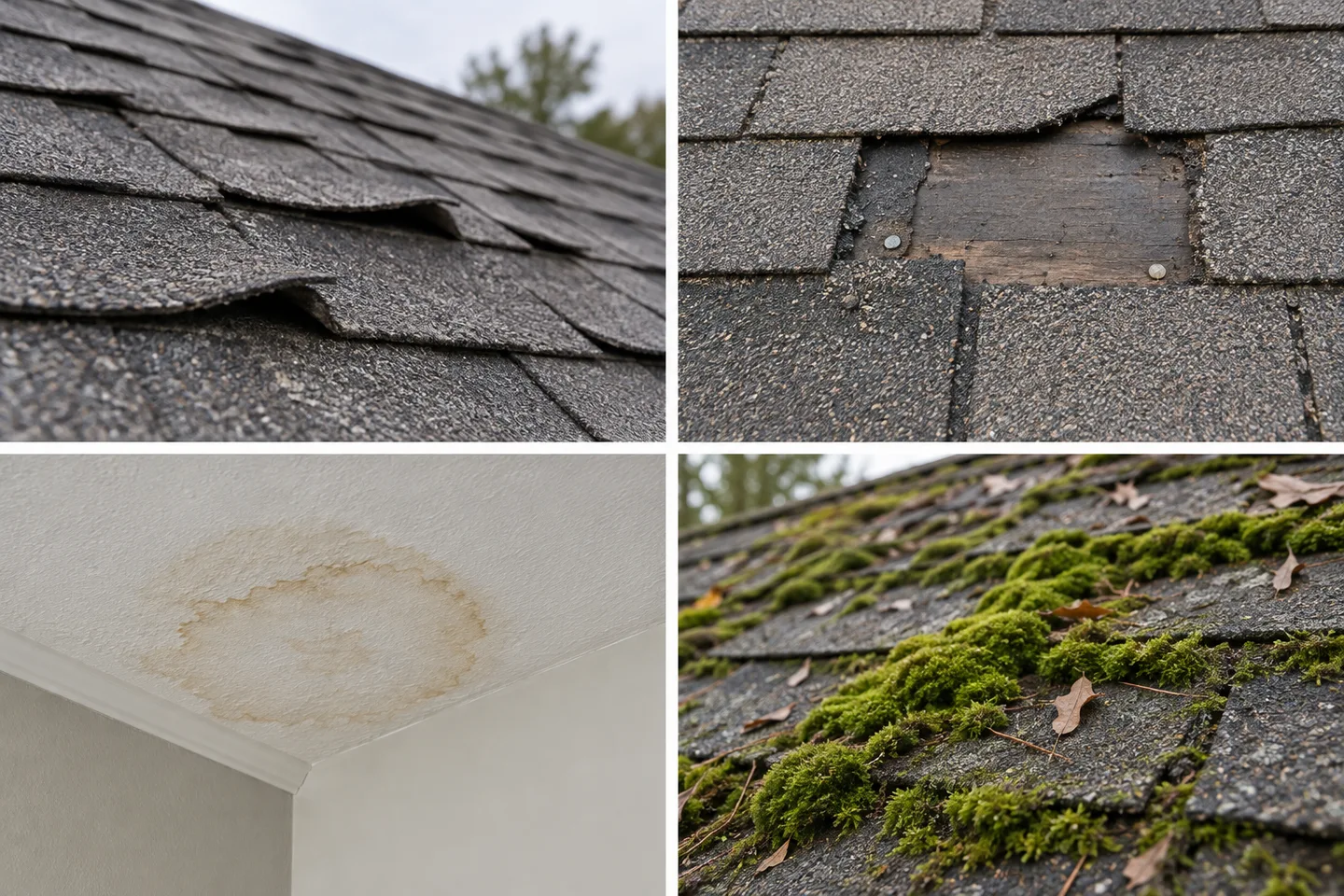
1. Age and maintenance history
Find the installation date, product information, past repairs and warranty documents. Broad planning discussions often place asphalt around a few decades, metal across several decades, and durable tile or slate longer still. Actual service life depends on the product, installation, climate and maintenance. A warranty duration is not a replacement schedule.
| Roof family | Published planning reference | What to inspect |
|---|---|---|
| Three-tab asphalt | About 20 years in InterNACHI’s planning chart | Brittleness, missing units, granule loss and flashings |
| Architectural asphalt | About 30 years in the same chart | Lamination, exposure and installation condition |
| Metal | 40–70+ years in manufacturer Interlock’s guidance | Fasteners, coatings, seams and corrosion |
| Concrete or clay tile | 50–100+ years in industry-association guidance | Broken pieces, support, underlayment and flashings |
| Natural slate | 60–125+ years in National Park Service guidance | Slate quality, roof configuration, location and supporting details |
Reference figures describe different materials and conditions, not a uniform replacement schedule. Sources: InterNACHI · Interlock · Tile Roofing Industry Alliance · National Park Service.
These are broad service-life discussion ranges, not guarantees. Evaluate condition with a qualified roofer instead of replacing a sound roof solely because it reaches a number.
2. Damaged or missing covering
Look for widespread curling, cracking, missing shingles or large exposed areas where granules have worn away. Localized damage may be repairable; repeated failures or deterioration across several planes can justify a replacement assessment.
3. Water entering the building
Ceiling stains, attic drips, damp insulation or persistent mold indicate a moisture problem that needs investigation. The entry point can be some distance from the visible stain. Plumbing, condensation and wall details can also cause moisture, so do not assume every stain means the entire roof has failed.
4. Unexplained heating or cooling changes
A change in bills can prompt an insulation, ventilation and air-leakage assessment. Roof work alone is not a guaranteed energy-saving solution; diagnose the cause before paying for a replacement as an efficiency measure.
5. Moss, algae and persistent debris
Dense moss and debris can retain moisture and interfere with drainage. Dark algae staining alone is not proof of structural failure. Ask for a product-appropriate cleaning and inspection approach; aggressive cleaning can damage the covering.
Inspect from a safe location. Leave steep-roof access, intrusive assessment and repair work to appropriately equipped professionals.
Worked roofing estimate examples
Illustrative calculations, not market quotes. Replace these assumptions with your own costs and measurements.
A measured asphalt replacement
A contractor measures a simple 40 × 40 ft horizontal roof area at a 5:12 pitch. The footprint is 1,600 ft², or 16 ground squares.
- Sloping area: 1,600 × 13 ÷ 12 = 1,733.33 ft².
- Material-only assumption: 1,733.33 × $3 = $5,200.
- Installation labor allowance: 100 crew-hours × $45 = $4,500.
- Base materials and installation: $5,200 + $4,500 = $9,700.
- Add separately quoted removal/disposal of $2,500 and permits of $300: $12,500 before any other excluded scope.
Material ordering waste, deck repairs, overhead, profit and tax must be included where applicable. A crew of four working 25 hours represents 100 crew-hours, not 25 labor-hours.
Comparing installed and material-only quotes
For a 1,700 ft² roof, Quote A is an installed $8/ft², including materials and installation labor. Quote B lists $4/ft² in materials and $6,800 in installation labor.
- Quote A: 1,700 × $8 = $13,600.
- Quote B: (1,700 × $4) + $6,800 = $13,600.
The base arithmetic matches, but that does not establish equal value. Compare removal, underlayment, flashing, ventilation, warranty and disposal line by line. Adding another $6,800 labor allowance to Quote A would double-count installation.
Allowing for discovered decking damage
An agreed base roof quote is $14,000. Once the old covering is removed, the owner approves replacement of six damaged sheets at an agreed installed price of $115 per sheet.
Approved extra = 6 × $115 = $690
Revised price = $14,000 + $690 = $14,690
Revised price = $14,000 + $690 = $14,690
Attach photos, quantities and written approval to the revised estimate. A documented unit-rate change is clearer than an unexplained contingency charge. Confirm whether tax and disposal are included in the $115 rate.
Roofing cost calculator questions
What would a roof for a 2,000 ft² home cost?
First determine whether 2,000 ft² means interior floor area, horizontal footprint or measured roof surface. Only the last can be multiplied directly by an installed roof-area rate. For an actual 2,000 ft² roof, illustrative $6–$9/ft² quotes produce $12,000–$18,000 before excluded work.
- Confirm material grade and complete system accessories.
- Allow for slopes, dormers and detailed transitions.
- Check old-layer removal, disposal, decking and permits.
A two-story 2,000 ft² house can have a much smaller footprint than a one-story house of the same interior area. Do not use one price for both without measuring.
How do I calculate a roof replacement budget?
- Measure the horizontal roof area, including overhangs and roofed extensions.
- Apply the correct slope factor, or measure each roof plane directly.
- Choose a complete material specification and a quoted material-only or installed rate.
- Include removal, disposal and any known deck repairs.
- Itemize underlayment, membranes, flashing, trim, permits and inspection fees not already included.
- Confirm height, access and local requirements with the contractor.
- Review a clear written total, assumptions and unit prices for concealed damage.
Use material-only costs in the calculator when adding labor separately. Round purchasing quantities according to the supplier's packaging after calculating the measured area.
What is the average roof replacement cost in North Carolina?
A single statewide average does not establish the price for a particular North Carolina roof. Coastal exposure, local labor, delivery, municipal permits, roof size and covering type can produce very different bids. We do not present an unverified statewide average as a current price.
For a transparent comparison, a measured 2,000 ft² roof quoted at an illustrative installed $7/ft² has a $14,000 base price. At $11/ft², the same area costs $22,000. Obtain equivalent-scope local bids and check their exclusions; these example rates are not North Carolina market measurements.
How much is replacing 1,000 ft² of roofing?
At assumed installed rates of $6–$9/ft², the base calculation is $6,000–$9,000. Add only work that is excluded from those rates. Small projects may also have minimum crew, transport or equipment charges, so cutting a large-roof quote in half does not always give the price of a smaller job.
Complex penetrations, premium materials, difficult access or concealed damage can raise the total substantially. Ask for an actual measured scope.
Can a roofing contractor offer financing?
Some contractors arrange financing through lenders. Availability, term, down payment and approval depend on the offer and applicant. Compare the cash price, financed amount, APR, fees, payment schedule and total repayment—not only the monthly payment.
For a promotional offer, distinguish a true introductory 0% APR from deferred interest and read what happens when the promotion ends. Do not assume approval or a particular term. The loan calculator can model stated loan inputs, but the lender's disclosure controls the actual agreement.
Will homeowners insurance pay for a replacement?
Coverage depends on the policy, cause of damage, exclusions, deductible and settlement terms. Sudden damage from a covered event may be treated differently from age, wear or neglected maintenance. Replacement-cost and actual-cash-value settlement can also lead to different out-of-pocket amounts.
Document damage safely and contact the insurer before relying on reimbursement. A contractor's estimate is not an insurance coverage decision. Ask the insurer how roof age, depreciation, matching and any recoverable depreciation apply to the specific claim.
Does a new roof increase a home's resale value?
A sound, attractive roof can improve buyer confidence and reduce concerns about immediate repairs. The amount recovered at sale depends on the local market, existing roof condition, material choice and the rest of the property. It is not guaranteed to equal the project cost.
For an illustrative resale scenario, spending $18,000 and attributing $12,000 of additional sale value to the work recovers 66.7% of the outlay. The unrecovered amount is $6,000. This is an example calculation, not a promised return or appraisal. Compare local evidence and use the ROI calculator with your own assumptions.
Why can a new roof be expensive?
- Materials: covering, underlayment, membranes, fasteners and details are all needed.
- Skilled labor: removal, preparation and installation take trained crew time.
- Waste: hauling, containers and disposal are part of the job.
- Permits: local administration and required inspections may add charges.
- Access: height, slopes, staging and safety equipment change the work.
- Business costs: insurance, licensing, supervision, overhead and warranty responsibilities affect the selling price.
A useful quote makes these inclusions visible. The cheapest total may omit items another contractor has included, so compare scope before choosing on price.
Explore more free calculators
View all calculators →
Sales tax calculator
Open calculator ↗Service price calculator
Open calculator ↗Profit margin calculator
Open calculator ↗Net salary calculator
Open calculator ↗More resources for your business

Business guides
Practical help with estimates, invoices, costs and cash flow.
Explore resource →
Invoice templates
Start with a professional layout for your next document.
Explore resource →
Free document tools
Prepare an itemized invoice or estimate online.
Explore resource →
Help & answers
Find answers about using Pocket Invoice.
Explore resource →Put your numbers into a professional estimate
A calculation is the starting point. Give your customer a clear description of the work, itemized prices and payment terms with Pocket Invoice.
- Build an estimate from your services and materials
- Add your business details, logo and terms
- Preview a PDF before sharing it with your customer
References & further reading
GAF: roof replacement cost and estimate factors ↗NRCA: roofing materials ↗NRCA: homeowner roofing resources ↗NAIC: roof insurance settlement methods ↗CFPB: deferred-interest promotions ↗InterNACHI ↗Interlock ↗Tile Roofing Industry Alliance ↗National Park Service ↗
Educational planning tools only. Confirm measurements, prices and applicable tax or lending rules before making a commitment.