
Lawn care price estimate
Free lawn care cost calculator
Enter lawn area and prices for mowing, aeration, dethatching, fertilizing, seeding, cleanup and weed control to estimate one visit.
Free, no sign-up, and the entered values stay in your browser.
How to use the lawn care cost calculator
Build a price for the area you maintain and the services included in a visit. Keep regular mowing, occasional treatments and one-time cleanup separate so the customer can understand exactly what the estimate covers.
Measure the maintained area
Exclude the house, driveway, patios and beds that are outside the mowing scope. Use the units displayed in the calculator. One acre equals 43,560 ft², so a quarter acre is 10,890 ft².
Enter mowing and additional services
Use your mowing unit rate, then add the work requested: edging, aeration, dethatching, fertilization, mulch cleanup, seeding, leaf removal, yard cleanup and weed control. Price only included work. Expand the service-range planner to enter a separate area and low and high unit rates for each service.
Apply discounts and check the scope
Apply an agreed percentage discount after adding the services. Review the per-visit amount and your delivery cost. A monthly or seasonal contract also needs the number of visits and a clear treatment schedule.
What can a lawn care estimate include?
Lawn care is not one uniform service. A mowing visit, a spring restoration and a full maintenance program use different equipment, materials and time. This calculator organizes the quantities and prices you enter; it does not diagnose turf problems or establish a universal local selling rate.
| Service | Define this before quoting |
|---|---|
| Lawn mowing | Maintained area, cutting height, trimming, edging and clipping handling. |
| Aeration | Area, access, core or other specified method, passes and cleanup. |
| Dethatching | Area, thatch condition, removal method and debris disposal. |
| Fertilization | Treatment area, suitable product, application quantity and timing. |
| Mulch cleanup | Whether the scope removes old material, prepares beds, supplies new mulch or only tidies the area. |
| Seeding | Area, preparation, seed specification and method, such as overseeding or another agreed application. |
| Leaf removal | Collection area, volume, bagging, transport and disposal. |
| Yard cleanup | The exact debris, beds, paths and other areas included; avoid duplicating leaf or mulch work. |
| Weed control | Treatment area, target problem, chosen method and any applicable application requirements. |
Explain whether supplies, travel, equipment, disposal and tax are included. A price for mowing alone should not be compared with a quote that also removes leaves, treats weeds and cleans beds. Once the scope is agreed, transfer the line items to a customer estimate or invoice.
How lawn care prices are calculated
1. Put area and rate in matching units
One acre is exactly 43,560 ft². Multiply acres by 43,560 to obtain square feet, or multiply ft² by 0.09290304 for m². A rate per 1,000 ft² must be applied to area divided by 1,000—not to every individual square foot.
Mowing charge = maintained ft² ÷ 1,000 × mowing rate
Extra service = service quantity × its unit price
Extra service = service quantity × its unit price
For example, 6,000 ft² at an assumed $9 per 1,000 ft² gives a $54 mowing charge. In metric mode, follow the rate unit shown on screen; switching the currency does not convert a dollar market quote into a local-market rate.
2. Calculate each service separately
Aeration may apply to the whole lawn while seeding applies only to damaged areas. Leaves may be priced by collection area, volume or a flat visit charge. Select the unit that describes the work and show it in the estimate. Do not multiply a complete-job flat fee by the lawn area.
3. Build a low-to-high planning range
When time or condition is uncertain, use a justified low and high rate for each service. Keep the same scope at both ends of the range; otherwise the customer cannot tell whether the difference is uncertainty or additional work.
Low service estimate = area × low unit rate
High service estimate = area × high unit rate
Low total = sum of low service amounts
High total = sum of high service amounts
High service estimate = area × high unit rate
Low total = sum of low service amounts
High total = sum of high service amounts
For a 6,000 ft² mowing area and example rates of $8–$10 per 1,000 ft², mowing is $48–$60. If edging and cleanup together are $26, the visit range becomes $74–$86. These inputs demonstrate a range; they are not industry-standard rates.
4. Apply the discount to both ends
Discounted amount = amount × (1 − discount percentage ÷ 100)
A 5% discount changes $74–$86 to $70.30–$81.70. The same rule applies to a fixed quote: an $80 visit becomes $76. Review the remaining profit before offering the reduction, and state whether seasonal extras receive the same discount.
Seven practical ways to improve lawn care margins
1. Measure the real cost of a visit
Record crew time, employer payroll costs, fuel, consumables, equipment upkeep, materials, disposal and allocated overhead. Insurance, marketing and administration still need to be paid even when they do not appear as customer-facing line items.
Job margin = (selling price − included job costs) ÷ selling price × 100
Be consistent about cost scope. A gross job margin that leaves out office overhead is not the same as the business's net profit margin. Compare planned and actual costs on completed visits before changing prices.
2. Offer clear packages and suitable recurring plans
A basic package could include mowing, defined edging and a hard-surface blowdown. A broader lawn-health package could add scheduled aeration, fertilization and weed management. State the number of treatments and their timing; do not imply every treatment happens on every visit.
Six- or twelve-month agreements can make scheduling more predictable. Price the actual number of visits, seasonal growth and weather interruptions. A recurring discount should reflect savings in travel, acquisition or administration, not an assumption that every repeat booking is automatically cheaper to serve.
Describe the value of reliable attendance, tidy work and a clearly maintained property. Avoid promising a particular turf result when irrigation, weather, soil and customer maintenance remain outside your control.
3. Reduce avoidable fuel, travel and purchasing costs
- Group neighboring properties so crews spend less paid time traveling between jobs.
- Maintain vehicles, blades and machines before breakdowns disrupt the schedule.
- Compare bulk fertilizer, seed and mulch purchases with storage capacity and actual usage.
- Standardize suitable supplies where it improves purchasing terms without compromising the job.
A discount on stock that expires or sits unused is not a saving. Include storage, handling and delivery when comparing suppliers.

4. Improve crew productivity without lowering quality
Use a checklist for setup, mowing, edges, cleanup and final inspection. Train team members in the tasks they are qualified to perform, and make routine equipment checks part of the schedule. Actual production records are more useful than the machine's advertised maximum speed.
Where appropriate, reward efficient work that also meets safety and quality standards. A bonus based only on speed can encourage missed details or unsafe operation. Compare paid crew-hours, not just the time one person spends on site.
5. Price relevant extras, seasonal work and referrals
Offer leaf removal, additional bed work or other suitable services when a property needs them. Gutter cleaning, pest treatments or seasonal lighting may require different skills, equipment or licensing; only offer them within the business's actual capabilities.
Spring preparation and autumn cleanup packages should have their own scope. For referral incentives, compare the reward with the cost of acquiring a profitable new customer. Do not give a large discount on every future visit for a one-time referral unless the economics support it.
6. Shorten the quotation and payment process
Prepare a clear estimate before work, then issue an itemized invoice promptly. Include agreed payment terms and the payment methods your business actually accepts. Card, bank transfer or mobile payment options can help customers pay conveniently, but processing charges belong in the cost model.
Digital documents reduce repeated entry and make revisions easier to communicate. They do not eliminate the need to check quantities, taxes, customer approval and payment status.
7. Review performance regularly
- Revenue and cost per job: identify routes or scopes that repeatedly exceed the estimate.
- Average invoice value: distinguish a genuine package improvement from simply doing more unpaid work.
- Customer acquisition cost: include advertising and sales effort, not only referral rewards.
- Customer lifetime value: consider retention and servicing costs instead of multiplying revenue indefinitely.
- Monthly or quarterly review: update prices and scheduling when costs, weather or service requirements change.
Use the profit margin calculator to compare equivalent cost scopes and the service price calculator to build a cost-based selling price.
Property size and the area you actually maintain
Size bands help organize a quote, but they are not a substitute for measurement. The following planning categories are convenient examples, not an industry classification. A narrow, obstructed lawn may take longer than a larger open one.
| Planning category | Maintained area | Approximate acreage |
|---|---|---|
| Small | Up to 8,000 ft² | Up to 0.18 acre |
| Medium | Above 8,000 to 14,000 ft² | About 0.18–0.32 acre |
| Large | Above 14,000 to 24,000 ft² | About 0.32–0.55 acre |
Divide irregular shapes into rectangles, triangles or other measurable parts. Exclude buildings, paved areas and any beds that are not in the mowing scope. Record edging length and areas needing special treatment separately; neither is fully described by the total lawn size.
How service frequency changes the quote
One-time visits
A one-time cleanup or pre-event visit may involve unfamiliar access, overgrowth and more setup. Inspect the condition before using the same per-visit price as a maintained weekly account. State whether the result includes waste removal.
Biweekly or monthly scheduling
Longer gaps can mean more growth and clipping handling. The appropriate interval depends on turf growth, weather and the agreed standard. A monthly plan is not automatically just one fourth of a weekly plan.
Weekly maintenance
Frequent visits can make the work more predictable and fit a dense route. The possible saving should be measured against actual time and travel. State the season, expected visit count, weather policy and how extra visits are authorized.
For all three options, distinguish per-visit price from monthly billing. A month can contain more than four weekly service dates. Fixed monthly billing should describe how the annual or seasonal contract amount is spread across payments.
Six factors that change lawn care costs
- Grass type and condition: cutting requirements, blade condition, density, moisture and overgrowth affect the number of passes and cleanup.
- Terrain: slopes, uneven ground and wet areas may require slower work or different equipment. Safety limits take priority over speed.
- Obstacles: trees, beds, play equipment and furniture add maneuvering, trimming and preparation.
- Access: gate width, steps, parking and the distance from the vehicle determine which machines can reach the lawn.
- Local operating costs: wages, fuel, insurance, disposal and travel time differ by route and market.
- Seasonal demand: growth and leaf-fall patterns affect staffing, frequency and workload. May–September is not a universal growing season for every climate.
Price the effect you can identify. For instance, an additional 20 crew-minutes at a loaded $36/hour adds $12 in labor cost. That is more transparent than applying an unexplained seasonal or “difficult lawn” percentage to every customer.
Match equipment to the property
Larger equipment is useful only when the site allows it to work efficiently. Access, slopes and maneuvering can outweigh nominal cutting speed. Use manufacturer operating limits and your own time records.
| Equipment | Where to assess it | Illustrative effective mowing rate |
|---|---|---|
| Push mower | Small or restricted areas; transport and physical workload matter | 0.25 acre/hour |
| Self-propelled walk-behind | Accessible medium areas; check slope and traction suitability | 0.50 acre/hour |
| Riding or zero-turn mower | Larger open areas with sufficient access; obey slope limits | 1–2 acres/hour |
The rates above are scenario assumptions, not machine specifications or productivity guarantees. At 0.25 acre/hour, a quarter acre requires one mowing hour; at 0.50 acre/hour it requires half an hour. Both still need loading, travel, edging and cleanup.
Include fuel or charging, blades, servicing, depreciation and financing where applicable. Do not count the same ownership cost once in your hourly rate and again as a full equipment surcharge. Compare total paid time saved against the additional machine cost.
Compare one-time, weekly and monthly prices
The following examples demonstrate how a service menu can be presented. They are not current U.S. price averages. Each assumes the same defined mowing scope within its row, with occasional treatments and tax excluded.
| Example maintained area | One-time visit | Recurring weekly visit | Four-visit illustration |
|---|---|---|---|
| Small: 6,000 ft² | $60 | $50 | 4 × $50 = $200 |
| Medium: 11,000 ft² | $90 | $75 | 4 × $75 = $300 |
| Large: 20,000 ft² | $140 | $120 | 4 × $120 = $480 |
A four-visit total is not a promise that every calendar month has four visits. Include minimum service charges, distant travel or unusual conditions explicitly. Aeration, seeding and major cleanups should appear as separate seasonal items rather than quietly changing the basic mowing price.
Check each package against delivery cost. If the recurring small-lawn visit costs $42 to perform, a $50 selling price leaves $8, or 16% of revenue, before any costs excluded from that $42. Offering another $10 discount would turn that scope into a loss.
Turn the calculation into a clear lawn care estimate
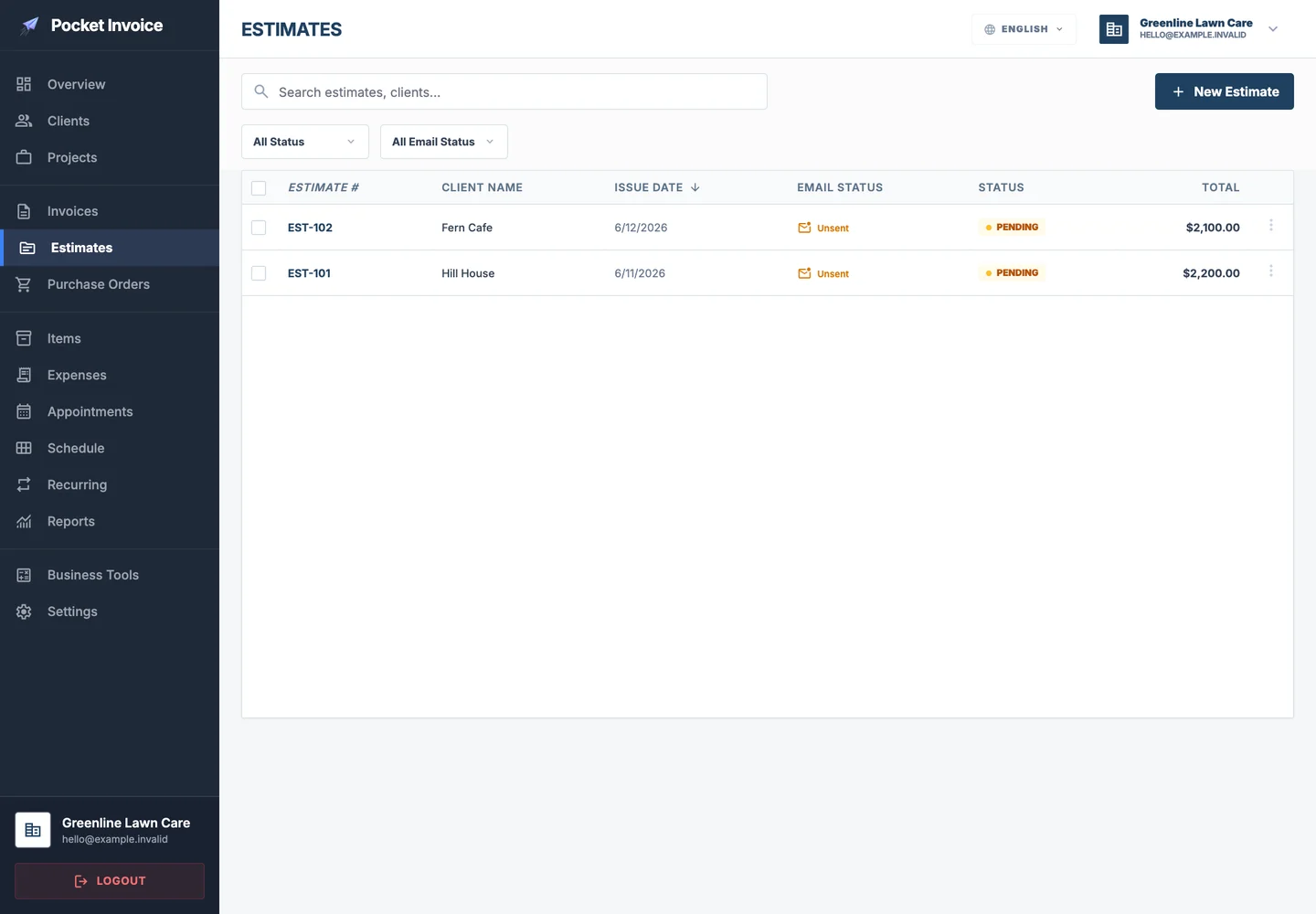
Move the agreed quantities and prices into a customer-facing document. Include the property, maintained area, visit frequency, service list, exclusions, discounts, taxes and payment terms. For seasonal contracts, list treatment dates or conditions separately from routine mowing.
- Quick preparation: the free estimate generator provides fields for customer details and itemized work without requiring an account.
- Phone-friendly editing: review the estimate on a small screen as well as a desktop before sharing it.
- PDF output: download a document for email, printing or the customer's records.
- Your business identity: use your business details and branding rather than sending an unlabelled calculation.
- Clear revisions: update quantities and prices before agreement, and identify any later change in scope.
A calculator result alone does not record customer approval or collect a deposit. Put the required approval, deposit and payment arrangements into the quote and use the corresponding tools actually enabled for your business.
Worked lawn care pricing examples
Illustrative calculations, not market quotes. Replace these assumptions with your own costs and measurements.
A mowing visit with two extras
A maintained 6,000 ft² lawn uses an example mowing rate of $9 per 1,000 ft². The agreed scope also includes $12 of edging and $14 of cleanup.
- Mowing: 6,000 ÷ 1,000 × $9 = $54.
- Additional services: $12 + $14 = $26.
- Per-visit selling price: $54 + $26 = $80.
Confirm that fuel, equipment and travel are already represented in these selling rates. If they are not, revise the rates before issuing the quote. This is the price for one visit, not a monthly total.
A recurring discount and its effect on profit
The same $80 visit receives a 5% recurring discount. Delivery costs are assumed to be $60 per visit.
Discount = $80 × 5% = $4
New price = $76
Profit at the stated cost = $76 − $60 = $16
Margin = $16 ÷ $76 × 100 = 21.05%
New price = $76
Profit at the stated cost = $76 − $60 = $16
Margin = $16 ÷ $76 × 100 = 21.05%
Before the discount, profit was $20. A 5% price reduction therefore reduces dollar profit by 20% when costs stay unchanged. Four scheduled visits cost the customer $304, but additional service dates must be handled according to the agreement.
A seasonal aeration and seeding scope
A property needs a $90 mowing visit, $100 in aeration and $70 in seeding. The treatment areas and seed quantity have been assessed separately from the mowing area.
Combined price = $90 + $100 + $70 = $260
List the application method, included materials and customer aftercare separately. Check whether weed treatment, weather or watering requirements affect timing. The next routine mowing visit should return to its own agreed scope; the customer is not buying aeration and seeding on every visit.
Lawn care pricing questions
How do I calculate a lawn care price?
- Measure the serviceable area and convert the units consistently.
- Choose the services and establish area-based, hourly or fixed rates for each.
- Calculate each line item and add only the work included.
- Check that labor, materials, travel, equipment and overhead are covered.
- Set profit using a clearly defined margin or markup, then assess any discount.
For a target 20% margin on a true $64 delivery cost, price at $64 ÷ 0.80 = $80. Adding 20% to cost would instead produce $76.80 and a 16.67% margin. Do not add full labor and overhead a second time if your service rates already include them.
What is the one-third rule for mowing?
The guideline is to remove no more than one third of the grass blade's height in one cut. For a target height of 3 inches, mowing before the grass exceeds about 4.5 inches keeps the cut within that proportion. University of Minnesota Extension explains the rule and why scalping stresses turf.
Choose the target height and frequency for the grass species and growing conditions. Overgrown lawns may need staged work rather than one aggressive cut, which can change the time and price of a visit.
What should a lawn mowing quote contain?
- Property address, maintained area and access details.
- Grass condition, slopes, obstacles and the agreed finish.
- Estimated crew-hours, equipment, travel and disposal requirements.
- Itemized mowing, edging, cleanup and any treatments.
- Visit frequency, discounts, taxes, payment terms and exclusions.
Estimate mowing time as area divided by effective productivity, then add preparation, trimming and cleanup. State how extra work, poor weather and missed access will be handled. A short but specific scope is more useful than an unexplained total.
How much should lawn care employees be paid?
Use current local wage requirements, experience, qualifications and the work involved. As a dated national comparison, the U.S. Bureau of Labor Statistics reports a median $19.27 hourly wage for grounds maintenance workers in May 2025. That occupational figure is not a legal minimum, a local offer or the full employer cost.
- Hourly pay: track all compensable work, including applicable travel and setup.
- Piece or route pay: speed incentives do not remove wage, overtime or recordkeeping obligations.
- Benefits and bonuses: include the employer's costs when estimating labor, and reward safe, reliable work.
Payroll taxes, insurance, paid leave and training can make loaded labor cost higher than the wage. Confirm applicable employment rules with a qualified local adviser.
What is a good lawn care profit margin?
Distinguish the direct-service gross margin from the net margin after overhead and other expenses. There is no universal percentage that makes every lawn business healthy. Service mix, route density, seasonality, equipment ownership and owner compensation all affect the result.
For planning, compare net-margin scenarios of 5%, 10%, 15% and 20% instead of treating them as guaranteed industry averages. At $10,000 of revenue those scenarios leave $500, $1,000, $1,500 and $2,000 respectively after the costs included in your definition.
A hypothetical 50–55% gross margin can still produce a low net margin if overhead is high. For example, $10,000 revenue less $4,800 direct cost gives 52% gross margin; subtracting another $4,200 in overhead leaves $1,000, or 10% before other excluded expenses. New businesses should measure actual results as routes mature instead of assuming growth alone will produce a target margin.
Explore more free calculators
View all calculators →
Sales tax calculator
Open calculator ↗Service price calculator
Open calculator ↗Profit margin calculator
Open calculator ↗Net salary calculator
Open calculator ↗More resources for your business

Business guides
Practical help with estimates, invoices, costs and cash flow.
Explore resource →
Invoice templates
Start with a professional layout for your next document.
Explore resource →
Free document tools
Prepare an itemized invoice or estimate online.
Explore resource →
Help & answers
Find answers about using Pocket Invoice.
Explore resource →Put your numbers into a professional estimate
A calculation is the starting point. Give your customer a clear description of the work, itemized prices and payment terms with Pocket Invoice.
- Build an estimate from your services and materials
- Add your business details, logo and terms
- Preview a PDF before sharing it with your customer
References & further reading
University of Minnesota Extension: mowing practices ↗BLS: grounds maintenance work and pay ↗OSHA: landscaping safety ↗
Educational planning tools only. Confirm measurements, prices and applicable tax or lending rules before making a commitment.