
Interior room paint estimate
Free paint cost calculator
Enter room dimensions, openings, ceiling area, primer and finish coverage, paint prices and labor rates to estimate material quantities and total job cost.
Free, no sign-up, and the entered values stay in your browser.
How to use the paint cost calculator
A useful painting estimate starts with measured surfaces and a defined finish, not the home's floor area alone. Use this worksheet to calculate paint and primer, then build a complete quote with preparation, labor, supplies, overhead and profit. The guide below explains each stage and shows how to compare different scopes.
Measure walls and openings
Enter room length, width and wall height. Subtract the combined area of doors and windows that will not receive the wall finish.
Add ceilings and trim
Enter ceiling area when included. Measure trim separately, and use the same units as the worksheet. Separate jobs with different paint systems.
Set products and labor
Enter finish and primer coats, their coverage and prices, plus total labor-hours and hourly cost. Review quantities before rounding purchases to available container sizes.
What you can estimate before sending a painting quote
The calculator turns room dimensions, openings, ceiling and trim area into an estimated coating quantity. It then combines the paint and primer prices with the labor-hours and hourly rate you enter. It is useful for a homeowner planning materials or a painting contractor checking a job budget.
- Separate quantities from prices. A gallon estimate is not a complete labor-and-material quote. Review both before deciding what to charge.
- Compare a range. Run a measured base case, then change the preparation hours, product price or number of coats to see a more demanding case. Save the assumptions with the quote instead of presenting a range with no explanation.
- Include the complete scope. Primer, woodwork, repairs, decorative finishes, masking and cleanup may need separate lines or a separate calculation when their products differ.
- Choose a profit method deliberately. Adding a percentage to cost is markup. A target margin requires dividing the full cost by the part of revenue left after that margin.
Results use your inputs; they are not a live regional price database. For multiple rooms, calculate each room or coating system and combine the results. Do not group different colors into a single purchase quantity unless the same product will actually be used.
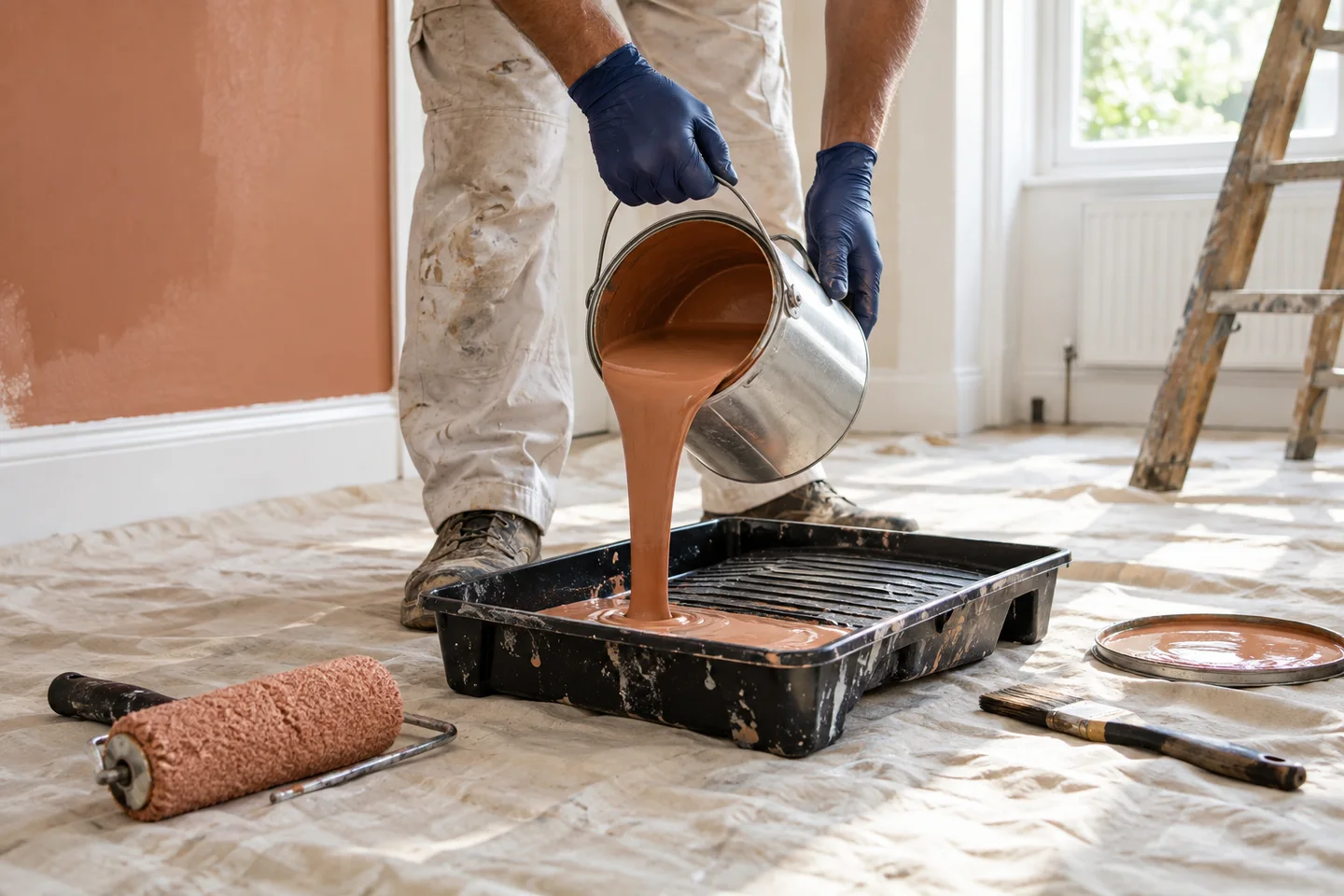
Measure the surfaces and calculate paint, primer and labor
For a rectangular room, wall area comes from the perimeter multiplied by height. The ceiling is a separate horizontal surface. Subtract only the openings that will not receive the wall coating; doors, frames and trim that will be painted need their own measured area.
Wall area = 2 × (length + width) × height − unpainted openings
Total coated area = wall area + included ceiling + included trim
Finish quantity = coated area × finish coats ÷ finish coverage
Primer quantity = primed area × primer coats ÷ primer coverage
Coating cost = finish quantity × finish price + primer quantity × primer price
Labor cost = total person-hours × hourly labor cost
Total coated area = wall area + included ceiling + included trim
Finish quantity = coated area × finish coats ÷ finish coverage
Primer quantity = primed area × primer coats ÷ primer coverage
Coating cost = finish quantity × finish price + primer quantity × primer price
Labor cost = total person-hours × hourly labor cost
Coverage is an area per unit of paint, such as ft² per gallon or m² per liter. It belongs in the denominator. Use the same measurement system throughout. Convert 10 feet 6 inches to 10.5 feet before entering a decimal dimension. A molding measured by length needs a painted width too: 80 ft of trim with 6 inches of developed painted width has an area of 80 × 6 ÷ 12 = 40 ft².
Primer and finish can have different coverage. Porous substrates, texture, application method and waste affect the quantity actually used. Benjamin Moore's estimating guidance also describes calculator quantities as rough estimates and notes that application conditions matter. Read the selected product's technical data sheet before buying.
Purchase rounding is a separate step. A result of 3.38 gallons does not mean you can buy exactly that quantity. Round by available container size for each product and color. Keep any allowance for touch-ups visible rather than hiding it in every input.
To turn cost into a selling price, first add consumables, repair materials, access equipment and allocated overhead. For a target margin of 25%, divide that complete cost by 0.75. To add a 25% markup instead, multiply it by 1.25. The two prices are different.
Build the estimate from the site visit to the final price
1. Inspect and measure
Record each room's dimensions, ceiling height, openings and included surfaces. Identify furniture that must be moved, floors to protect, access restrictions and whether occupants will remain in the rooms. Note bare drywall, chalky exterior coatings, glossy finishes, stains and failed paint separately; equal areas do not necessarily take equal time.
2. Specify the coating system and supplies
Write down the product, finish, color and coat count for walls, ceilings and woodwork. Decide which surfaces require primer or stain blocking. Price paint and primer, then add tape, roller covers, brushes, caulk, patching materials, abrasives and drop cloth use. Compare total installed cost, not only the price of a can.
3. Estimate person-hours by phase
Separate protection and preparation from cutting in, rolling, trim work and cleanup. Divide the relevant area by your crew's observed production rate, then add activities that an area rate does not cover. An illustrative application rate of 175 ft² per person-hour means 700 ft² takes four application hours per coat; it does not include every preparation or return visit.
4. Allocate overhead and choose profit
Include the project's share of vehicle costs, equipment depreciation, insurance, scheduling, software and administration. Use a loaded labor cost when estimating employee expense; wages alone may omit payroll taxes, benefits and paid nonproductive time. Keep overhead out of the calculation a second time if it is already included in the selling rate.
5. Review and document the offer
Check quantities and container sizes, then compare the result against equivalent local scopes. Clearly describe excluded repairs, extra coats caused by a changed color choice, client access requirements and how additional work will be approved. Show taxes separately where applicable.
Professional estimator's final checklist
- Site inspection: condition, access, occupied areas and safe working requirements.
- Quantity takeoff: walls, ceilings, doors, frames, trim and decorative surfaces.
- Crew plan: people, person-hours, task sequence and return visits.
- Material schedule: paint, primer, caulk, masking and protection.
- Overhead allocation: vehicle, equipment, insurance and administration.
- Profit and uncertainty: stated pricing method and a documented allowance for genuinely uncertain work.
A contingency is not the same as profit. For planning, you might compare a 5% and a 10% allowance on an uncertain repair scope; those are assumptions to discuss, not universal percentages for every painting job.
Compare area-based, hourly and room-based painting prices
There is no single fair rate for all painting work. A meaningful comparison names the surfaces, preparation standard, product, coats, access and exclusions. A price per square foot of floor area cannot be compared directly with a price per square foot of painted wall.
The following amounts are illustrative quote-planning scenarios, not measured market averages or recommended rates. They demonstrate common pricing formats. Replace them with your actual costs and local comparable quotations.
| Pricing format | Illustrative inputs | What to confirm |
|---|---|---|
| Interior surface pricing | $2.50–$4.50 per painted ft² | Walls only or walls and ceiling; protection, repairs and coats |
| Exterior surface pricing | $2–$4 per painted ft² | Siding condition, height, access equipment and weather delays |
| Hourly selling rate | $35–$55 per person-hour | Whether materials, overhead, travel and taxes are included |
| Bedroom fixed quote | $300–$500 | Dimensions, openings, furniture and included woodwork |
| Bathroom fixed quote | $250–$450 | Small-space access, moisture damage and compatible finish |
| Kitchen fixed quote | $450–$850 | Walls versus cabinets; grease removal and appliance protection |
A small bathroom can have less wall area yet require more detailed work per square foot. Cabinet refinishing is not simply another wall surface. When a quote is much lower, ask what has been left out before assuming it is more efficient.
To compare low and high cases, change specific assumptions: repair hours, finish grade, access or coat count. Keep measured dimensions consistent so the reason for the price difference is visible.
A worked budget for a home with 1,000 ft² of floor area
Floor area describes the footprint, not all paintable surfaces. Room partitions, ceiling heights, doors and windows can produce different painting quantities in two homes with the same floor area. Start with a room schedule and total the measured areas.
Suppose the rooms in one 1,000-ft² home total 2,800 ft² of included wall and ceiling surfaces. The following example uses one primer coat and two finish coats throughout. It intentionally separates the physical quantity from the rounded purchase.
| Budget item | Calculation | Amount |
|---|---|---|
| Finish paint | 2,800 × 2 ÷ 350 = 16 gal; $45/gal | $720 |
| Primer, calculated | 2,800 ÷ 300 = 9.33 gal; $30/gal | $280 |
| Primer, purchased | Round 9.33 gal to 10 gal at $30 | $300 |
| Labor | 50 person-hours × $40 | $2,000 |
| Consumables and protection | Project allowance | $180 |
| Allocated overhead | Project allocation | $300 |
Using the purchased quantity, the complete illustrated cost is $720 + $300 + $2,000 + $180 + $300 = $3,500. At a 25% target margin, the selling price is $3,500 ÷ 0.75 = $4,666.67 before applicable taxes. The calculator's paint, primer and labor subtotal is narrower than this complete quote.
If damaged surfaces require another $800 of repairs, complete cost becomes $4,300 and the same margin method produces $5,733.33. Premium coatings require a separate price and coverage comparison rather than an arbitrary whole-house surcharge.
Exterior work needs another measured scope. For example, 1,600 ft² of measured exterior coating area at an illustrative all-in $3 per ft² gives $4,800, provided that rate actually covers the specified labor, materials and access. It is not derived from the home's 1,000-ft² floor area and should not be added unless exterior work is included.
Six practical ways to improve painting-job profitability
- Measure crew time by task. Track preparation, application, trim and cleanup separately. Use checklists and cross-training to make handovers clearer. Compare quality and rework as well as speed; a rushed coat that must be redone costs more.
- Buy against a measured material schedule. Ask suppliers about legitimate volume pricing and standardize frequently used products where suitable. Balance any discount against storage, color-specific leftovers, shelf life and cash tied up in stock.
- Price additional services separately. Decorative finishes, accent walls and color consultation need defined scope and their own labor allowance. Offer them because they meet the client's needs, not because every job must include an upgrade.
- Reduce travel and idle time. Group nearby projects, confirm access and materials before arrival, and schedule return visits around the product's drying requirements. Do not shorten curing or recoating time simply to make the calendar look better.
- Keep estimate and invoice details consistent. List accepted changes, additional rooms and extra coats so completed work is not accidentally omitted from the bill. A reusable document structure reduces repeated administrative work.
- Review rates against completed jobs. Compare quoted and actual costs regularly, including a quarterly review of wages, coatings and overhead. A higher selling rate only helps if the complete job still meets the customer's expectations and your cost assumptions.
Look at both margin percentage and total dollars earned. A high-margin small job may leave less money than a larger job with a lower percentage, especially when travel and setup occupy the same amount of time.
Seven factors that change painting time and cost
| Factor | Why it matters | What to record |
|---|---|---|
| Surface area and height | More area needs more coating; high walls can change the working method. | Measured area, height and access plan |
| Paint quality and finish | Products differ in price, coverage, substrate suitability and coat requirements. | Exact product, finish, technical data and current supplier quote |
| Preparation and repairs | Cracks, staining, loose coatings and damp damage may require distinct tasks. | Repair scope and cause of any moisture problem |
| Access and detail | Stairs, occupied rooms, ornate profiles and multiple stories reduce simple area-based productivity. | Protection, movement of furniture and equipment |
| Location | Labor availability, travel, parking and delivery conditions differ. | Job address, travel assumptions and local costs |
| Season and conditions | Humidity, temperature, rain and scheduling affect exterior work and drying. | Product application limits and likely return visits |
| Crew experience | Skill affects sequencing, finish quality and rework, not merely hourly wage. | Loaded rate and measured production history |
Assess coating hazards before disturbing old surfaces. In the United States, EPA's renovation, repair and painting guidance explains requirements for covered work in pre-1978 properties. Hazard assessment and compliant work practices cannot be replaced by a larger contingency in a calculator.
Turn the painting budget into a clear customer estimate
Once the price is checked, use Pocket Invoice's estimate generator to describe exactly what the customer is buying. Keep the document specific to painting rather than sending a total with no surface or product information.
- Start with the job details: enter customer and business information without rebuilding the document layout.
- Work on a phone or computer: review the scope where the measurements are taken.
- Prepare a PDF: preview the finished document before sharing or printing it.
- Use your own branding: add the business name, logo and payment terms.
- Revise the working estimate: update quantities and prices when the agreed scope changes.
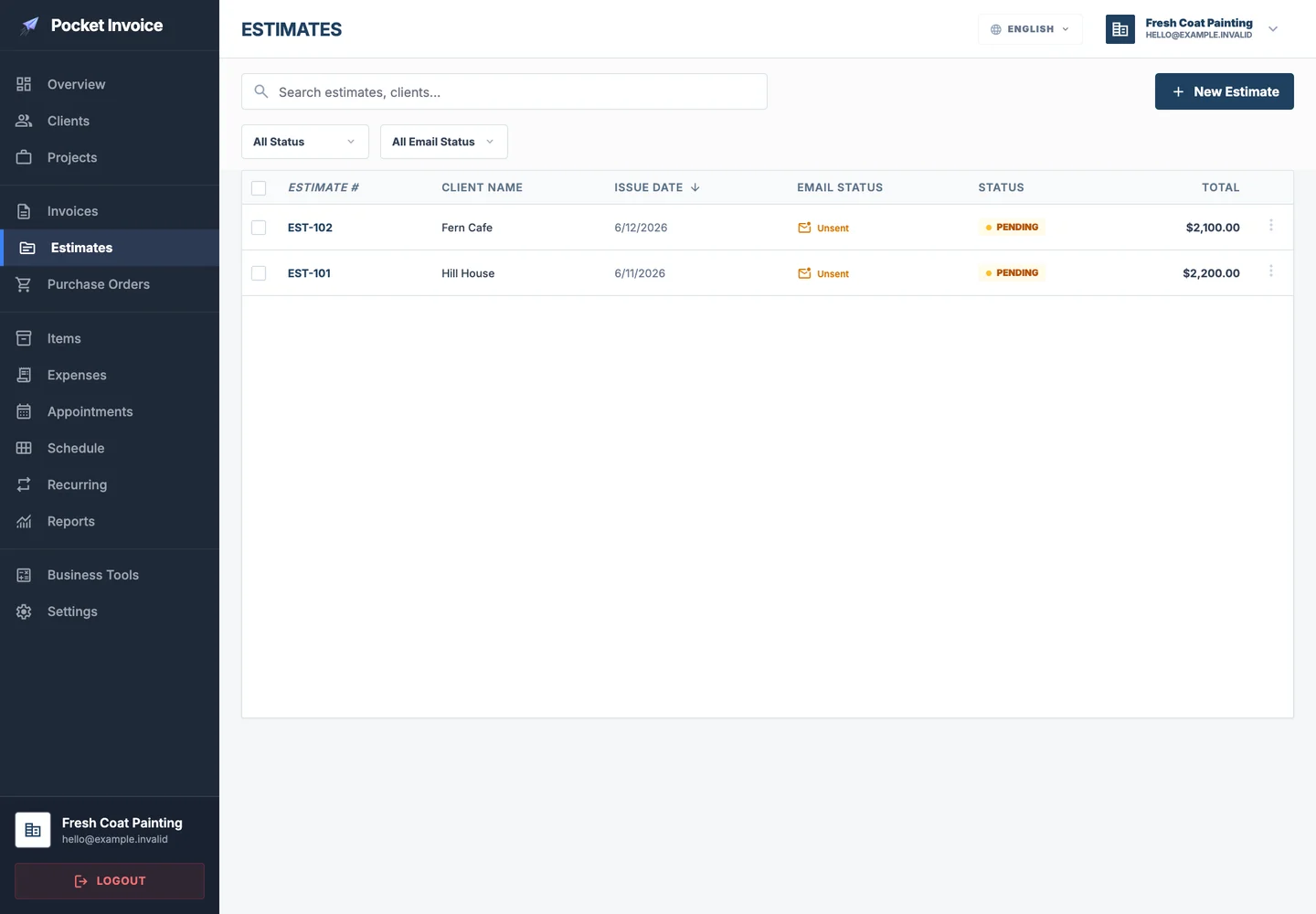
Include rooms and surfaces, paint specification, preparation, coat count, exclusions and the process for extra work. Document any deposit and payment schedule you agree separately; the painting calculator itself does not collect payments or authorize work.
Painting calculation examples
Illustrative calculations, not market quotes. Replace these assumptions with your own costs and measurements.
Measure a room before buying paint
A room is 16 ft long, 12 ft wide and 8 ft high. The combined unpainted door and window openings are 48 ft². The ceiling will also be painted, but trim uses another product and is excluded from this calculation.
- Perimeter = 2 × (16 + 12) = 56 ft.
- Gross wall area = 56 × 8 = 448 ft².
- Net walls = 448 − 48 = 400 ft².
- Ceiling = 16 × 12 = 192 ft².
- Total included area = 400 + 192 = 592 ft².
The room's 192-ft² floor area is therefore not a substitute for its 592-ft² included coating area. Use separate calculations if ceiling and wall products differ.
Calculate finish and primer separately
Use the 592-ft² area, two finish coats at 350 ft² per gallon and one primer coat at 300 ft² per gallon.
- Finish quantity = 592 × 2 ÷ 350 = 3.3829 gal.
- Primer quantity = 592 ÷ 300 = 1.9733 gal.
- At $45 per finish gallon, calculated finish cost = $152.23.
- At $30 per primer gallon, calculated primer cost = $59.20.
Calculated coating cost is $211.43. If only whole gallons are purchased, four finish gallons and two primer gallons cost $240. Record that $28.57 purchase-rounding difference rather than assuming the calculated fraction is the invoice total.
Move from delivery cost to a selling price
For the same room, allow 12 person-hours at a loaded cost of $40, $240 of purchased coatings, $60 of consumables and $120 of allocated overhead.
- Labor = 12 × $40 = $480.
- Complete cost = $480 + $240 + $60 + $120 = $900.
- For a 25% target margin, price = $900 ÷ 0.75 = $1,200.
- Profit on the included costs = $1,200 − $900 = $300.
- Margin = $300 ÷ $1,200 = 25%; markup = $300 ÷ $900 = 33.33%.
The rates are examples. Verify the preparation scope and all actual costs before presenting this as a customer quote.
Painting cost questions
How should I interpret a painting price per square foot?
Ask which area is being priced: floor area, actual wall area or all coated surfaces. Then check preparation, products, coats, ceilings, trim and access. A stated rate without these details is not a comparable quote. The price scenarios above illustrate formats, not a national average or a guaranteed local price.
How do I calculate paint quantities and the material budget?
- Measure each coated surface and remove unpainted openings.
- Multiply by the specified coat count.
- Divide by the selected product's coverage in matching units.
- Round purchases by product, color and available container size.
- Multiply purchased quantities by prices and add primer, tape, brushes, rollers, caulk and protection.
Do not assume primer and finish cover the same area per gallon. Keep different coating systems separate.
Should preparation and cleanup be included?
Yes. Protection, filling, sanding where safe, appropriate priming, removal of masking and final cleanup take paid time. List them explicitly or state that the quoted labor includes them. For a sensitivity exercise, adding 10–25% to application-only labor can show the effect of extra work, but it is not a substitute for measuring preparation: a badly damaged room may require much more.
How do additional coats and better-quality paint change the estimate?
Every additional coat adds material and application time. The total-job increase is not a universal percentage because setup and preparation may not repeat. A more expensive product may have different coverage or application requirements; compare the manufacturer's system and actual production time. Do not promise fewer coats or longer life solely because the price per gallon is higher.
How accurate is the estimate?
The arithmetic follows the quantities and prices you provide. Accuracy depends on measurements, substrate condition, coat specification, real coverage, purchase rounding and labor assumptions. It is not guaranteed to fall within a fixed percentage of the final job. Inspect the site and compare actual completed-job records before committing to a price.
Can I leave out ceilings or trim?
Yes. Enter zero for surfaces outside the scope. Subtract openings that do not receive the wall coating, then calculate painted doors, frames or woodwork separately where their products differ. The worksheet's subtotal does not automatically include every repair, overhead item, profit or tax.
Explore more free calculators
View all calculators →
Roofing cost calculator
Open calculator ↗Service price calculator
Open calculator ↗Profit margin calculator
Open calculator ↗Sales tax calculator
Open calculator ↗More resources for your business

Business guides
Practical help with estimates, invoices, costs and cash flow.
Explore resource →
Invoice templates
Start with a professional layout for your next document.
Explore resource →
Free document tools
Prepare an itemized invoice or estimate online.
Explore resource →
Help & answers
Find answers about using Pocket Invoice.
Explore resource →Put your numbers into a professional estimate
A calculation is the starting point. Give your customer a clear description of the work, itemized prices and payment terms with Pocket Invoice.
- Build an estimate from your services and materials
- Add your business details, logo and terms
- Preview a PDF before sharing it with your customer
References & further reading
Educational planning tools only. Confirm measurements, prices and applicable tax or lending rules before making a commitment.