
House cleaning estimate
Free house cleaning cost calculator
Enter home size, room counts, visit level and requested floor, appliance, window and laundry add-ons to estimate a cleaning price.
Free, no sign-up, and the entered values stay in your browser.
How to use the house cleaning cost calculator
Estimate the agreed cleaning scope using the home's rooms or floor area, the visit type and any extra tasks. Then compare the selling price with the actual time, supplies and overhead required to perform the work.
Choose rooms or floor area
Use the method that matches your pricing. Count the bedrooms and bathrooms included, or enter the maintained floor area and your area rate. Do not add two complete base-clean prices for the same home.
Set the visit type and scope
Choose the appropriate level of work and adjust the entered rates to the property's condition. A recurring maintenance clean, first visit and move-out clean need different expectations.
Price extra tasks separately
Add floor treatments, interior appliances, window panels and laundry only when included. Confirm quantities and distinguish ordinary surface cleaning from specialist work.
Review the estimate before sharing
Check the base service, extras and total against expected crew-hours and delivery costs. State what is excluded, who supplies materials and how additional work will be approved.
What the house cleaning calculator helps you price
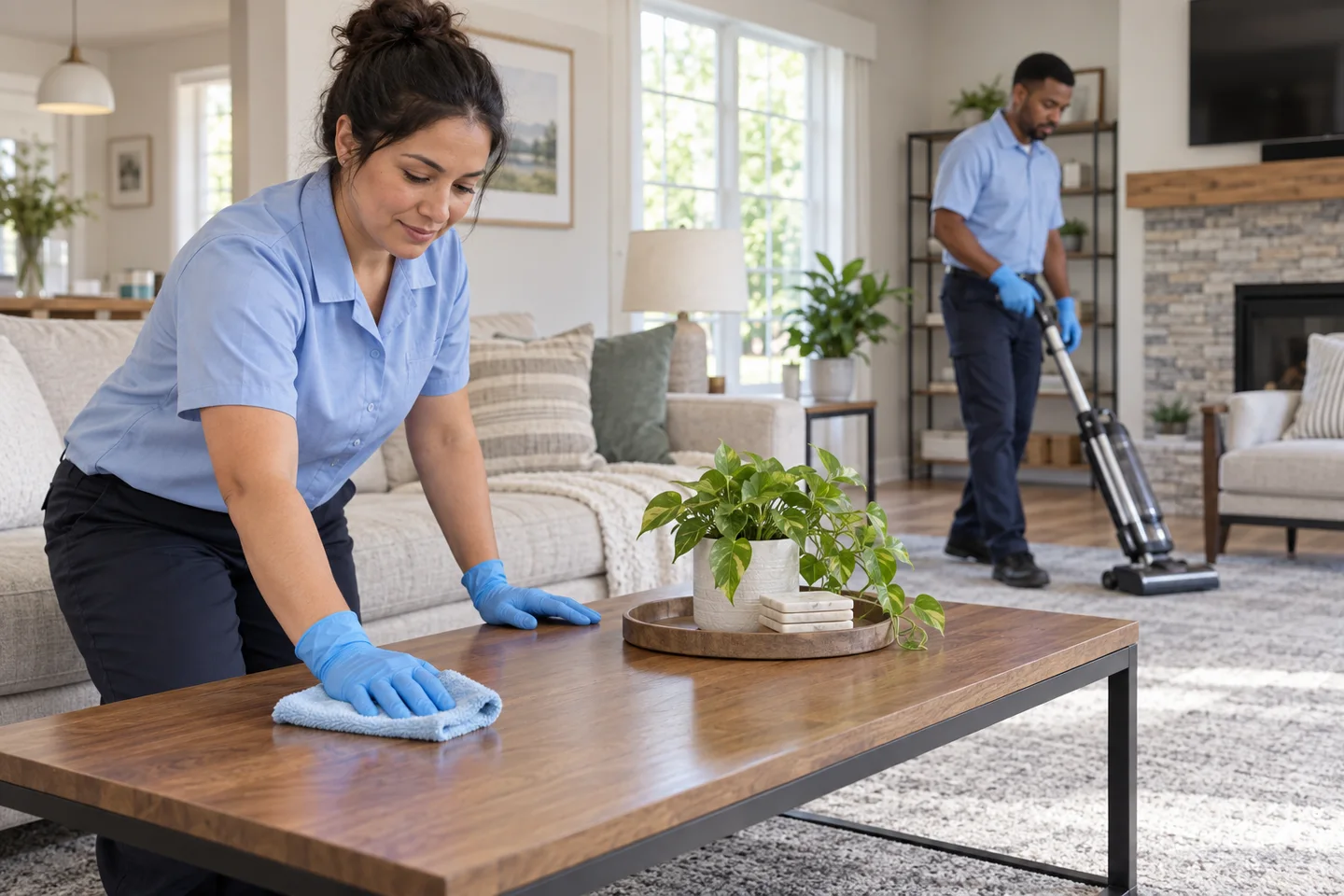
A cleaning estimate needs more than a property size. Kitchens, bathrooms, first-visit buildup, pets and optional tasks can change the work significantly. This worksheet brings the quantities and rates together so you can explain the price before the appointment.
- Base estimate: use room counts or area to organize the main cleaning scope.
- Service level: distinguish routine maintenance from deeper or one-time work.
- Optional services: add quantities and charges for floors, appliances, windows and laundry.
- Profit review: compare the quoted amount with your costs using the profit margin calculator; the cleaning total alone is not a profit guarantee.
The entered rates are your assumptions, not live local quotes. The calculator does not inspect a home, choose a safe cleaning treatment or verify the time a particular team will need.
House cleaning pricing formulas
There are two useful but different ways to construct a price: a customer-facing service rate or a bottom-up cost calculation. Use them to cross-check one another. Do not combine them in a way that charges the same labor twice.
Area-based or room-based selling price
Area price = included floor area × selling rate per area unit
Room price = base visit charge + priced rooms
Quoted total = chosen base price + separately priced extras
Room price = base visit charge + priced rooms
Quoted total = chosen base price + separately priced extras
If your calculator rate is per 1,000 ft², divide area by 1,000 first. Floor treatments, appliances, window panels and laundry can each have different units. An oven charge is per appliance, not per square foot of the house.
Cost-based price check
Delivery cost = labor + supplies + equipment allowance + allocated overhead
Price for a target margin = delivery cost ÷ (1 − margin percentage ÷ 100)
Price for a target margin = delivery cost ÷ (1 − margin percentage ÷ 100)
Labor is paid crew-hours multiplied by loaded hourly cost. Overhead can include administration, insurance and travel costs not already included elsewhere. A 20% target margin on $160 of delivery cost gives $160 ÷ 0.80 = $200—not $192, which would be a 20% markup.
Building a price range
Where condition or time is uncertain, calculate low and high scenarios using the same included task list. For example, 2,000 ft² at illustrative $0.20–$0.35/ft² gives $400–$700 before extras. State what would move the job toward either end, and confirm a final price or approval process after assessment.
Materials, labor, overhead and profit must be covered somewhere, but not added a second time to an all-inclusive selling rate. Taxes, where applicable, should be shown according to the relevant rules.
How to price a house cleaning job step by step
- Measure the included space. Record bedrooms, bathrooms, kitchens, living areas and hallways. Exclude rooms the customer does not want serviced, and note stairs or difficult access.
- Agree the task list. Define standard, deep or move-in/move-out cleaning in writing. Specify interior appliances, inside windows, cabinet interiors and high-reach work separately.
- Apply the correct selling rates. Use a measured area, room schedule or time estimate. As an arithmetic example, a $0.15/ft² base rate on 1,600 ft² gives $240.
- Check labor and materials. Estimate crew-hours, consumables, equipment wear, setup and travel. Compare with records from similar completed jobs instead of assuming every home cleans at the same speed.
- Review overhead and profit. Confirm what the base rates already include, check a target-margin scenario and adjust the quote before customer approval.
A target margin of 15–25% can be explored as a planning scenario, not treated as a universal industry standard. For example, at a $180 delivery cost, a 15% margin requires $211.76 and a 25% margin requires $240. The chosen price must also fit the actual scope and market.
Compare competing estimates only after checking their inclusions. An inexpensive maintenance clean is not an equivalent offer to a deep clean with appliances, windows and upholstery.
Pricing a deep clean for a 2,000 ft² home
Deep cleaning usually means additional detail work, not simply applying a multiplier to the same task list. Ask about buildup, access, appliances, fixtures and excluded areas before setting a fixed price. Photos or a walkthrough can help clarify the scope.
Area-based example
| Assumed deep-clean rate | Calculation | Base price |
|---|---|---|
| $0.20/ft² | 2,000 × $0.20 | $400 |
| $0.30/ft² | 2,000 × $0.30 | $600 |
| $0.40/ft² | 2,000 × $0.40 | $800 |
These are illustrative rates, not a current national price survey. They show why changing the service level or rate changes the quote. Interior ovens, windows, laundry or specialist floor work remain separate when the base scope excludes them.
Room-based comparison
A room-based schedule can distinguish labor-intensive bathrooms from bedrooms. For example, a quoted $40 per bedroom and $65 per bathroom gives $250 for three bedrooms and two bathrooms. That is only the listed room subtotal; kitchen, common spaces, base visit work and extras still need a defined price.
Use the room method as an alternative schedule, not an automatic $250 addition to an area price that already includes those same rooms. The final estimate should make this distinction clear.
How long does cleaning a 2,000 ft² house take?
Separate labor-hours from elapsed appointment time. Two cleaners working four hours perform eight labor-hours. Dividing the crew size can estimate elapsed time, but setup, shared spaces and work sequencing mean the saving is not always perfectly proportional.
| Planning scenario | Assumed productivity per cleaner | Total labor-hours | Two-person elapsed estimate |
|---|---|---|---|
| Standard maintenance clean | 300–400 ft²/hour | About 5–6.7 hours | About 2.5–3.3 hours, before shared setup |
| Detailed deep clean | 200–250 ft²/hour | About 8–10 hours | About 4–5 hours, before shared setup |
These productivity assumptions are examples. Clutter, pet hair, grease, stairs, multiple bathrooms, delicate surfaces and optional tasks can add substantial time. Record actual durations on completed jobs and use them to improve future estimates.
Labor-hours = cleaned area ÷ effective productivity
Approximate elapsed time = labor-hours ÷ number of cleaners
Approximate elapsed time = labor-hours ÷ number of cleaners
Do not reduce the labor budget merely because a larger team finishes earlier. Four cleaners working two hours still represent eight labor-hours, and may also need travel and setup time.
What to do—and avoid—before a deep clean
Clear personal belongings instead of hiding the work
Put away toys, loose clothing, paperwork and valuables so the team can reach the surfaces being cleaned. Decluttering and organizing are separate services unless explicitly included. Do not move items into another room that is also scheduled for cleaning without telling the team.
Report or repair maintenance problems
Tell the provider about leaking taps, loose fixtures, damaged surfaces and anything that cannot be used safely. Cleaning does not repair a leak or restore a broken fitting. Agree whether affected areas should be excluded until repaired.
Make a safe plan for pets
Arrange a secure area for animals, explain access needs and move food or water bowls where the provider requests. Discuss pet hair, accidents and any specialist work before the visit instead of assuming it is included in a standard clean.
Communicate stains, damage and product restrictions
Identify delicate materials, existing scratches, stubborn stains, allergies or manufacturer care requirements. A provider should not promise to remove every stain before assessing the surface.
Follow product labels and keep chemicals safely stored. CDC guidance warns against mixing bleach or disinfectants with other cleaning products. An ordinary cleaning appointment is not automatically a mold-remediation or hazardous-material service.
Six ways to improve cleaning-job profitability
- Plan routes and appointments together. Group nearby work, allow realistic travel time and reduce gaps that leave crews paid but unavailable for another job.
- Offer clearly priced bundles. A deep-clean-plus-window package can be convenient, but list the window count and included surfaces. Extra work should not disappear inside an underpriced flat fee.
- Purchase supplies efficiently. Compare concentrated product yield, storage and actual usage, not just container price. Buying more than the business can safely store or use may create waste.
- Build recurring plans with defined scope. Weekly or biweekly visits can reduce first-visit buildup and administration. Price the observed saving and explain what happens when a visit is skipped.
- Prepare quotes and invoices promptly. Reuse accurate customer and item details, identify revisions and communicate payment terms. Faster paperwork helps organization but does not itself guarantee collection.
- Review rates regularly. A quarterly review can compare expected and actual crew-hours, supply costs, travel and customer scope. Adjust future quotes when the work consistently exceeds the budget.
Track profit after discounts as well as before them. At a $200 selling price and $160 delivery cost, profit is $40. A $20 discount cuts price by 10% but profit by 50% when costs stay the same. Review the amount left to cover any expenses excluded from the job-cost figure.
Seven factors that affect a house cleaning quote
- Area and layout: many small rooms, stairs and narrow spaces can take longer than a simple open plan of the same size.
- Service type: routine, deep, first-time and move-out work require different task lists.
- Bathrooms and kitchens: fixtures, grease and high-touch surfaces often require more detail than an empty bedroom.
- Frequency: the condition maintained between visits affects effort; a one-time visit may not match recurring productivity.
- Condition: clutter, accumulated dirt, pet hair and neglected surfaces can require additional labor.
- Location: wages, parking, travel and access arrangements change the cost of serving the property.
- Specialist tasks: appliances, interior glass, upholstery, stain treatment and special floor care need their own quantities and limits.
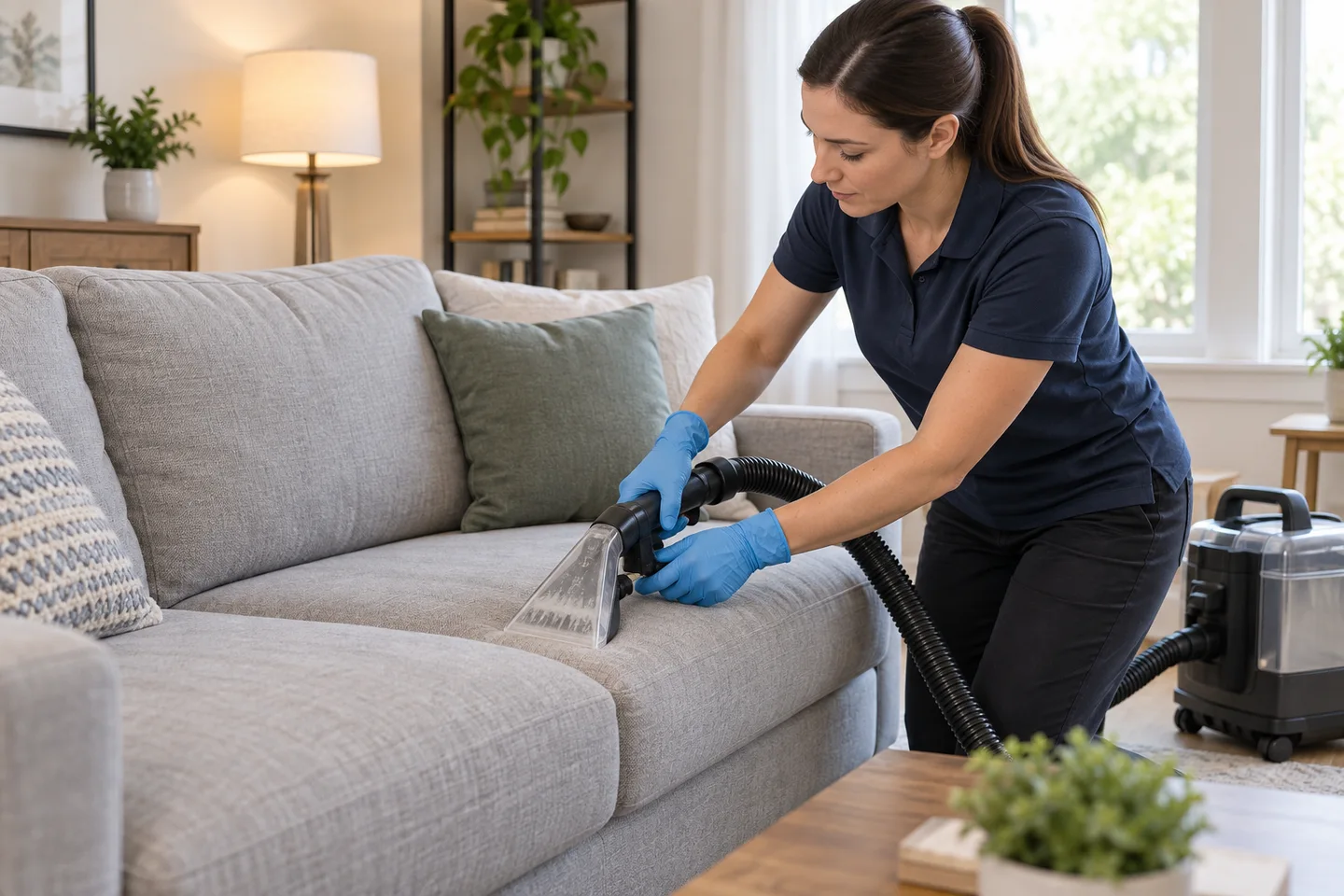
Ask what the basic visit includes before accepting a total. A clearly defined exclusion is more useful than discovering during the appointment that both parties expected different work.
Prepare and share a professional cleaning estimate
After calculating the price, create a document that connects it to a specific home, date and task list. Include business and customer details, room or area quantities, base cleaning, extras, discount, tax and payment terms.
- Start quickly: the free estimate generator can be used without an account.
- Work on a phone: review customer details and line items on the device you use during a site visit.
- Download a PDF: share or print a consistent document for the customer.
- Use your branding: include your business identity so the estimate is recognizable.
- Revise before agreement: adjust quantities or add-ons while discussing the scope, and identify changes clearly.
State deposit requirements, approval arrangements and accepted payment methods only as they apply to your business. The estimate calculator does not itself collect a signature or payment. Where the Pocket Invoice app is part of your workflow, use its actual enabled features to manage the next step.
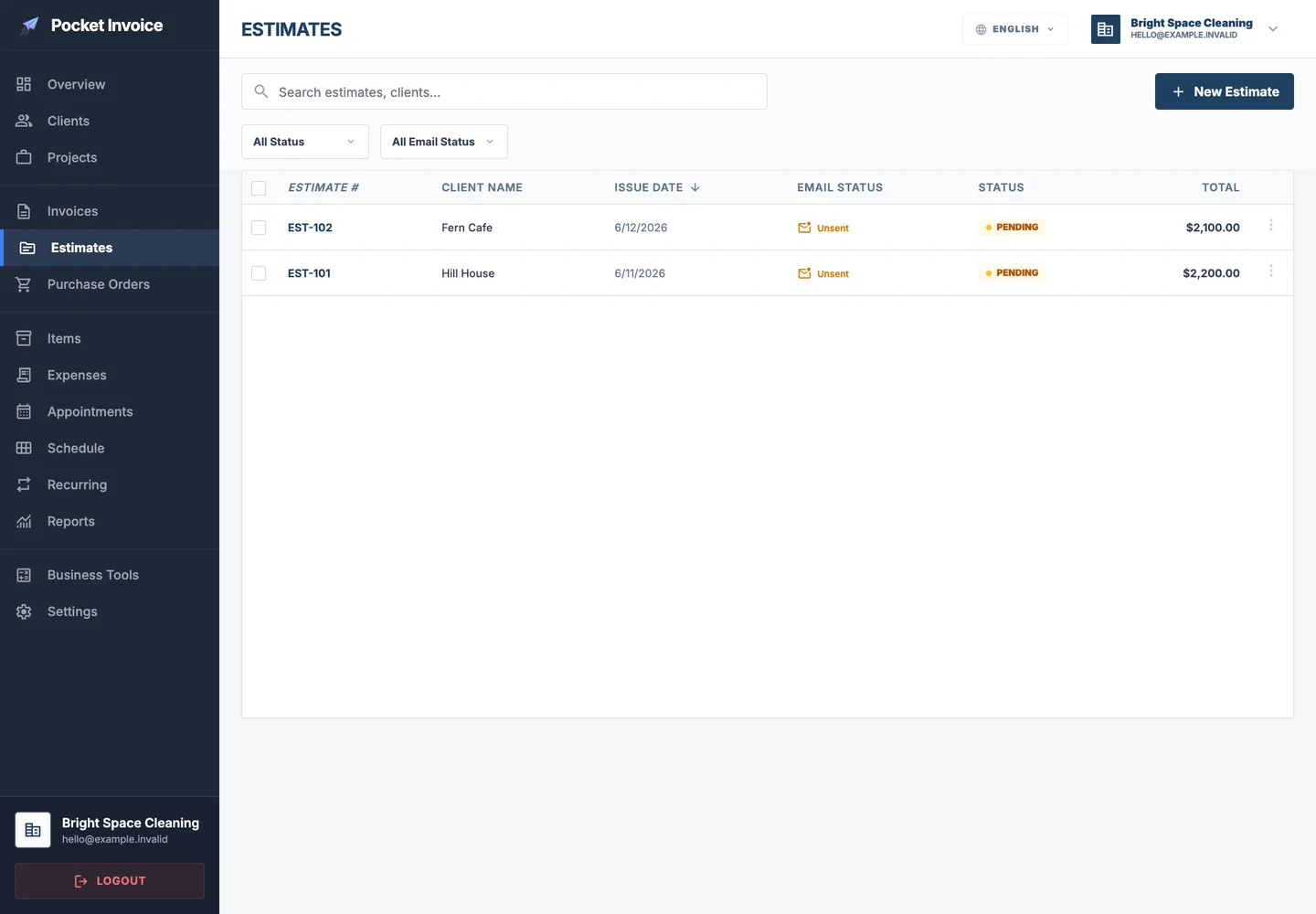
Worked house cleaning estimates
Illustrative calculations, not market quotes. Replace these assumptions with your own costs and measurements.
An area-based maintenance visit
A 1,600 ft² home is priced at an assumed $0.15/ft² for the agreed base cleaning. One interior appliance is a separately agreed $30 extra.
- Base price: 1,600 × $0.15 = $240.
- Extra task: 1 × $30 = $30.
- Quoted subtotal: $240 + $30 = $270.
If the calculator field is per 1,000 ft², the equivalent rate is $150 per 1,000 ft². Confirm that the appliance task is not already included in the base price and apply any relevant tax separately.
A deep-clean labor and margin check
A two-person team expects to spend four hours in a home, creating eight labor-hours. Assume a loaded labor cost of $25/hour, $20 in supplies and $40 of allocated equipment, travel and overhead.
Labor = 2 × 4 × $25 = $200
Delivery cost = $200 + $20 + $40 = $260
Price at 20% margin = $260 ÷ 0.80 = $325
Delivery cost = $200 + $20 + $40 = $260
Price at 20% margin = $260 ÷ 0.80 = $325
The resulting $65 profit is 20% of the $325 selling price. This example checks cost-based pricing; it should not be added on top of an all-inclusive area quote for the same work.
Approving extra windows before work
The original cleaning estimate is $240. The customer requests eight additional interior window panels at an agreed $7.50 per panel.
Window addition = 8 × $7.50 = $60
Revised subtotal = $240 + $60 = $300
Revised subtotal = $240 + $60 = $300
Confirm which sides, frames and tracks are included, and whether access changes the method. Record the revised scope before starting. Exterior or high-reach glass should not be assumed to have the same rate as accessible interior panels.
House cleaning cost questions
What is the average cleaning price per square foot?
There is no single rate that fits every home or local market. A useful comparison separates a standard maintenance scope from a deep clean, then checks bathrooms, kitchens, condition and optional tasks.
To explore the arithmetic, illustrative standard-clean rates of $0.08–$0.25/ft² produce $160–$500 on 2,000 ft². Illustrative deep-clean rates of $0.20–$0.40/ft² produce $400–$800. These are planning inputs, not a verified current national average or a recommendation to charge a particular amount.
Compare current local estimates for the same task list and check the cost of delivering your own service before adopting a rate.
Should house cleaners charge by the hour or by the job?
Hourly billing can suit work with uncertain conditions when the customer understands the rate, crew size and approval limit. A fixed job price is convenient when the scope and likely duration are clear. Area and room schedules are ways to prepare that price, not guarantees about how long the work will take.
- At an illustrative $40 per cleaner-hour, two cleaners working three hours produce a $240 labor-based selling amount.
- A fixed $240 quote stays $240 for the agreed scope even if the team finishes sooner, unless the agreement says otherwise.
- A deep-clean quote at $480 is a different service specification, not automatically twice the time or profit.
Hourly selling rates are not employee wages. Include overhead and other delivery costs, and explain whether supplies, travel and tax are additional. This calculator's room and area modes do not replace a timesheet or payroll system.
Should supplies and equipment be included in the estimate?
An all-inclusive price should account for what the provider supplies and uses. State any customer-supplied items or exclusions explicitly.
- Consumables: detergents, appropriate disinfectants, cloths, bags and other materials used on the job.
- Equipment ownership and wear: vacuum bags, mop heads, servicing and a reasonable equipment allowance.
- Travel and setup: time, mileage, parking and preparing or removing equipment.
Those costs may already be built into your room or area selling rates. They are not automatically known by the calculator, and adding them twice would overstate the quote. Allocate shared supplies by the amount used rather than charging every customer for the same full container.
Which extra charges can change a cleaning estimate?
- Pet-related work: extra hair removal or an agreed specialist task.
- Stain treatment: carpet or upholstery work that requires assessment, equipment and product compatibility.
- Heavy clutter: organizing, access work or excessive buildup outside the standard task list.
- Interior appliances: ovens, refrigerators or freezers where interiors are excluded from base cleaning.
- High-reach or exterior work: fans, upper trim or windows requiring different access equipment.
- Urgent or unusual appointments: a specifically agreed out-of-hours or short-notice service.
Quote the quantity, price and limits before work. Ordinary cleaners should not treat hazardous contamination, unsafe access or specialized remediation as a routine add-on without the appropriate capability.
How accurate is the cleaning calculator?
The arithmetic follows the quantities and rates entered. The accuracy of the actual job estimate depends on whether those inputs reflect the property, condition, team productivity and agreed scope. There is no verified universal “within 10%” guarantee.
Improve estimates by recording real crew-hours and supplies on completed jobs, comparing similar homes, and assessing unusual conditions before accepting a fixed price. For uncertain work, provide a clearly defined range or an approval limit and explain what could change it.
A calculator supports that process; it cannot substitute for a walkthrough or promise a particular profit margin.
Explore more free calculators
View all calculators →
Sales tax calculator
Open calculator ↗Service price calculator
Open calculator ↗Profit margin calculator
Open calculator ↗Net salary calculator
Open calculator ↗More resources for your business

Business guides
Practical help with estimates, invoices, costs and cash flow.
Explore resource →
Invoice templates
Start with a professional layout for your next document.
Explore resource →
Free document tools
Prepare an itemized invoice or estimate online.
Explore resource →
Help & answers
Find answers about using Pocket Invoice.
Explore resource →Put your numbers into a professional estimate
A calculation is the starting point. Give your customer a clear description of the work, itemized prices and payment terms with Pocket Invoice.
- Build an estimate from your services and materials
- Add your business details, logo and terms
- Preview a PDF before sharing it with your customer
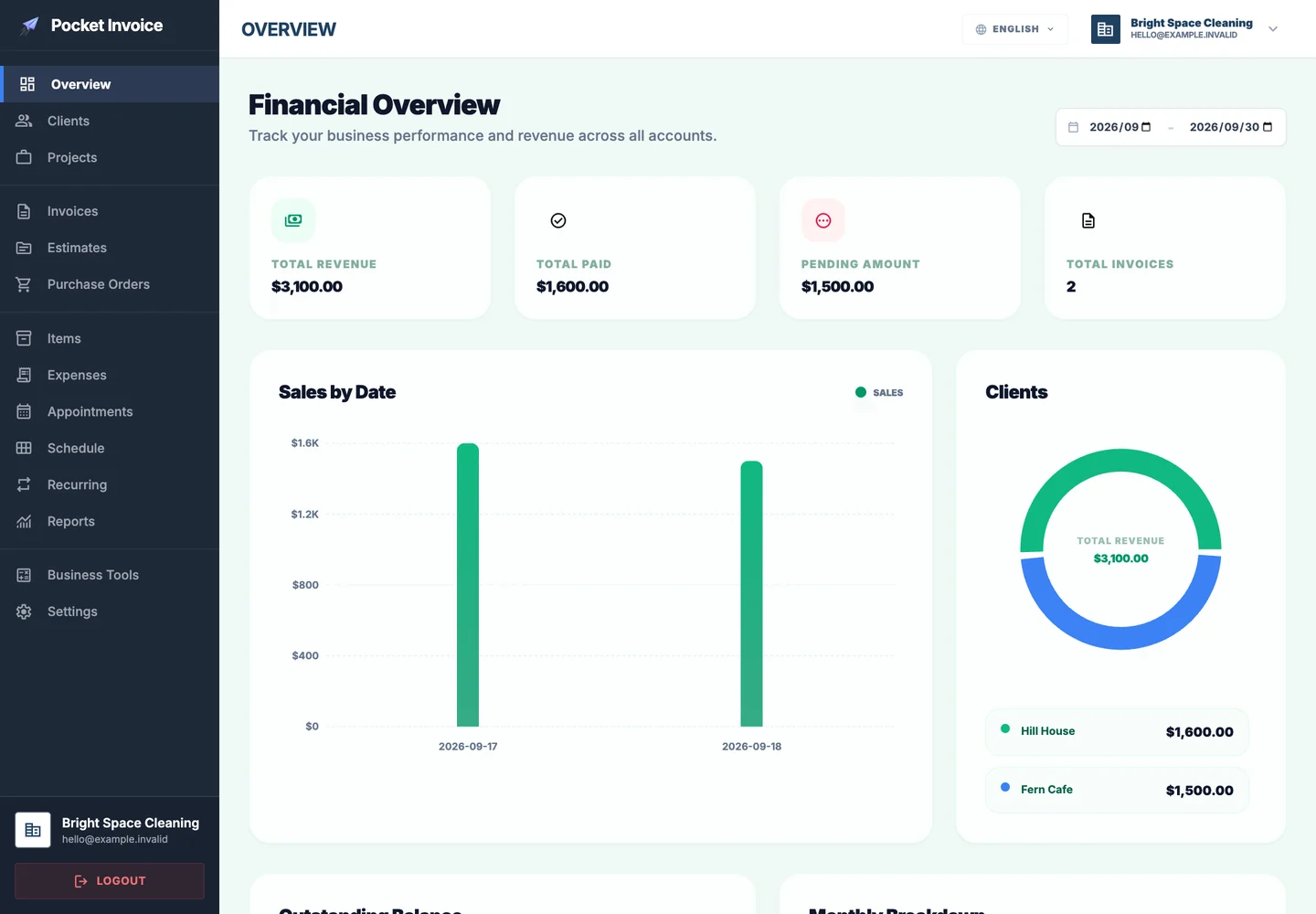
References & further reading
Educational planning tools only. Confirm measurements, prices and applicable tax or lending rules before making a commitment.