
Concrete volumeLive volume, weight and bag estimate
Free concrete calculator
Choose slabs and walls, round footings, circular slabs, curb and gutter, or stairs. Enter the requested dimensions and quantity to estimate volume, weight, 60 lb and 80 lb bags, waste and ready-mix cost in your browser.
Free, no sign-up, and no measurements leave this page.
How to use the concrete calculator
Choose the shape of the pour, enter its finished dimensions and quantity, then review volume, weight, bag count and material cost. The existing five shape modes include slabs and walls, round footings, circular slabs or tubes, curb and gutter, and solid stairs with a platform.
Choose the shape and units
Select the shape that matches the actual form. Use the unit displayed beside each dimension; in imperial mode a thickness may be in inches while a length is in feet. Circular inputs use diameters, not radii.
Enter dimensions and quantity
Measure the finished concrete space, not the surrounding excavation or overall floor area. Enter the number of identical forms. Calculate differing shapes separately and avoid counting overlapping concrete twice.
Set allowance and material price
Choose a job-specific waste allowance and enter the supplier price per cubic yard or cubic meter. The calculator applies the allowance before estimating bags, weight and material cost; the example price is not a current local quote.
Check the order and prepare an estimate
Confirm volume with the supplier, bag yield with the product label, and structural requirements with the project designer. Add delivery, labor, reinforcement, equipment, preparation, tax and terms in the job estimate.
Calculate concrete for slabs and walls
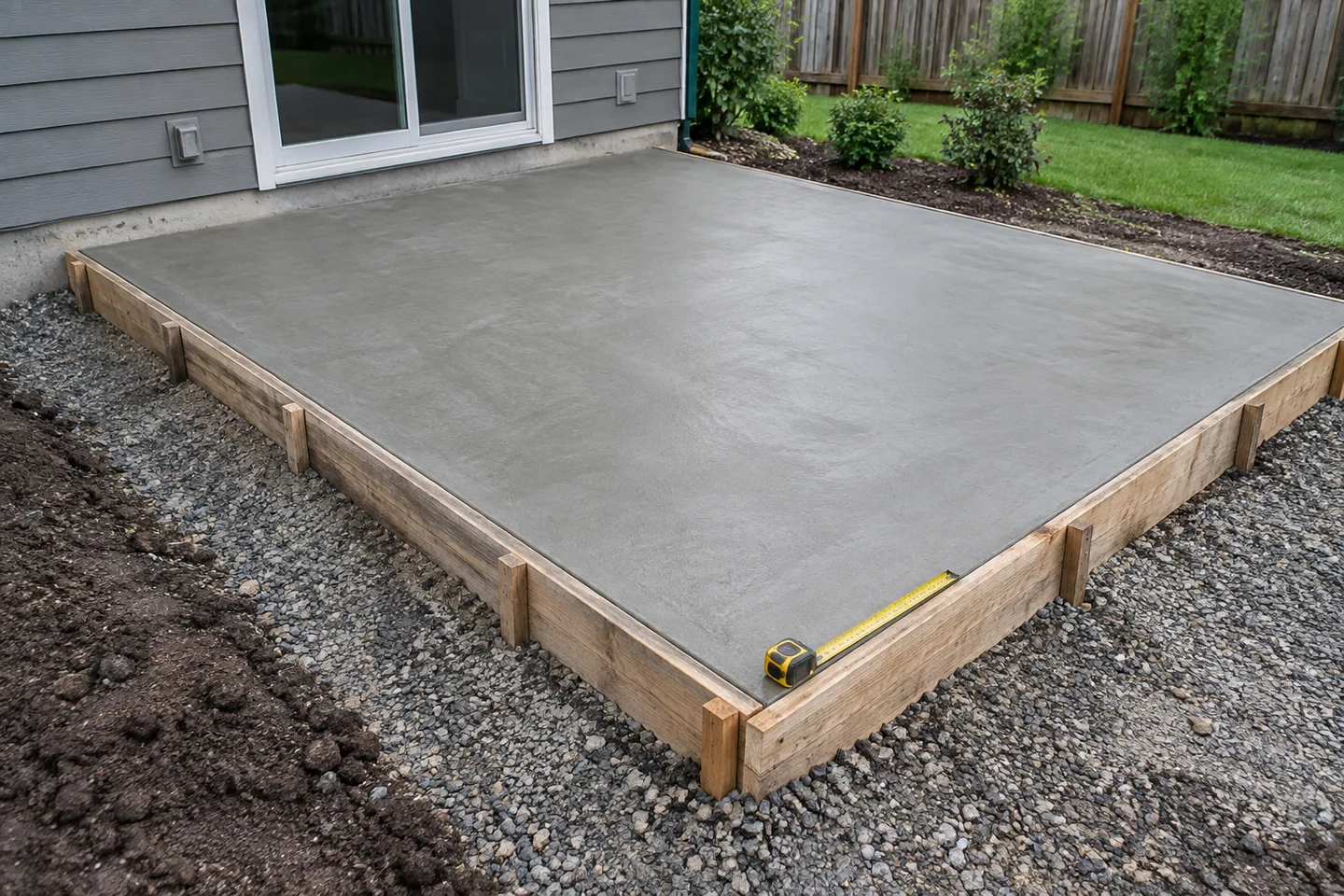
Rectangular concrete volume is the area of the face multiplied by its thickness. Use Slabs & walls for a patio, driveway panel, floor slab or rectangular wall. Enter length, width and thickness/height in the displayed units, then enter the quantity of identical pieces.
Measure and calculate
V = length × width × thickness × quantity
Cubic yards = cubic feet ÷ 27
Cubic yards = cubic feet ÷ 27
For an 18 ft × 12 ft slab that is 6 in thick, convert 6 in to 0.5 ft. Volume = 18 × 12 × 0.5 = 108 ft³ = 4 yd³ before allowance. With an illustrative 10% allowance, order-volume planning becomes 4.4 yd³. A wall uses the same geometry: length × height × wall thickness.
Separate thickened edges or beams from the uniform slab and add their extra volume without counting the slab thickness again. For wall openings, deduct only genuine voids that will not receive concrete. This volume estimate does not select a slab thickness, reinforcement or load capacity.
Calculate circular slabs and hollow concrete sections
Select Circular slabs for a round pad or annular section. The calculator asks for outer diameter, inner diameter, height/length and quantity. Set the inner diameter to zero for a solid circular slab; use the actual opening diameter for a ring or tube.
Solid circle: V = π × r² × depth
Ring or tube: V = π × (outer diameter² − inner diameter²) ÷ 4 × height
Ring or tube: V = π × (outer diameter² − inner diameter²) ÷ 4 × height
A 10 ft diameter pad has a radius of 5 ft. At 0.5 ft depth, V = π × 5² × 0.5 = 39.27 ft³, or about 1.45 yd³ before allowance. Enter 10 as the outer diameter, not 5.
For a hollow section with a 4 ft outer diameter, 2 ft inner diameter and 1 ft height, V = π × (4² − 2²) ÷ 4 × 1 = 9.42 ft³, or 0.35 yd³. The opening is a volume deduction; it must fit within the outside diameter. Do not use this mode for a tapered or irregular section without first breaking it into appropriate geometry.
Calculate square and rectangular footings
A square footing is simply a rectangle whose length equals its width. Use Slabs & walls and enter footing length, width and depth. The quantity field is useful for identical pad footings; separate rows of different sizes should be calculated independently.
Footing volume = length × width × depth × quantity
A rectangular footing measuring 10 ft × 2 ft × 1.5 ft contains 30 ft³, or 1.11 yd³ before allowance. Six separate footings measuring 2 ft × 2 ft × 1 ft contain 6 × 4 = 24 ft³, or 0.89 yd³.
For intersecting strip footings, add only non-overlapping segments. Excavation overbreak, uneven ground and delivery increments can affect the order allowance. Soil capacity, footing depth, frost protection and reinforcement are design requirements; a correct cubic-volume calculation does not establish structural adequacy.
Calculate round footings, columns and post holes
Use Round footings for a solid cylinder. Enter diameter through the center, depth/height and quantity. Measuring a radius but entering it as diameter would produce only one-quarter of the intended volume because the radius is squared.
V = π × (diameter ÷ 2)² × depth × quantity
Four cylindrical footings, each 3 ft in diameter and 2 ft deep, require π × 1.5² × 2 × 4 = 56.55 ft³, or 2.09 yd³ before allowance. For different depths, calculate each group and add the volumes.
The solid-cylinder result includes the full hole. If a post or another component displaces concrete, identify that displacement separately where appropriate to the supplier and project method. Do not automatically subtract reinforcement or structural components without an agreed quantity method.
Calculate an L-shaped curb and gutter
The calculator combines two non-overlapping rectangles: the curb and the adjacent gutter flag. Enter curb depth, curb height, gutter width, flag thickness, length and quantity. Here, curb depth means the horizontal width of the curb rectangle; gutter width is the adjoining flag width, not a width that also contains the curb.
Cross-section area = curb depth × curb height + gutter width × flag thickness
Volume = cross-section area × length × quantity
Volume = cross-section area × length × quantity
With a 6 in wide × 6 in high curb and an 18 in wide × 4 in thick gutter, the area is 0.5 × 0.5 + 1.5 × (4 ÷ 12) = 0.75 ft². Along 40 ft, volume is 30 ft³ = 1.11 yd³ before allowance.
If the curb height was measured only above the gutter surface, adjust the rectangle dimensions to match the actual non-overlapping section. For sloped, rounded or municipal standard profiles, use the approved cross-sectional area or divide the drawing into suitable shapes. A rectangular approximation is not a substitute for the specified curb detail.
Calculate solid concrete stairs with a platform
Select Stairs and enter run per step, rise per step, width, number of steps, platform depth and quantity. This calculator models a solid staircase filled down to a horizontal base, followed by a full-height solid platform. It does not model a thin suspended stair slab or a staircase filled mainly with compacted material.
Let n be the number of steps, r the rise, t the run, W the width and P the platform depth. The successive rectangular step columns have heights r, 2r, 3r and so on. Their sum is r × n(n + 1) ÷ 2.
Step volume = W × t × r × n(n + 1) ÷ 2
Platform volume = W × P × r × n
Total = (step volume + platform volume) × quantity
Platform volume = W × P × r × n
Total = (step volume + platform volume) × quantity
For 4 steps, each with a 1 ft run and 0.5 ft rise, a width of 4 ft and a 3 ft platform: steps = 4 × 1 × 0.5 × 10 = 20 ft³; platform = 4 × 3 × 0.5 × 4 = 24 ft³. Total = 44 ft³ = 1.63 yd³ before allowance. Set platform depth to zero if the solid platform is absent.
Multiplying one small step block by the step count misses the concrete beneath higher treads in this solid model. Conversely, applying this full-solid formula to a hollow or sloped-underside stair overstates the quantity. Use the actual section drawing.
Convert cubic feet, cubic yards and cubic meters
Linear, square and cubic units are different. A square-foot area needs a thickness before it becomes a concrete volume. Convert all dimensions to a common unit before multiplying; 4 inches is 4 ÷ 12 feet, not 4 feet.
| Conversion | Relationship |
|---|---|
| Inches to feet | in ÷ 12 |
| Centimeters to meters | cm ÷ 100 |
| Millimeters to meters | mm ÷ 1,000 |
| Cubic feet to cubic yards | ft³ ÷ 27 |
| Cubic yards to cubic meters | yd³ × 0.764554857984 |
| Cubic meters to liters | m³ × 1,000 |
A 6 m × 4 m slab with a 100 mm thickness contains 6 × 4 × 0.1 = 2.4 m³. A 24 ft × 15 ft slab at 6 in contains 180 ft³, or 6.67 yd³. Retain precision in the calculation, then agree the supplier's order increment.
Adjusted volume = measured volume × (1 + allowance % ÷ 100)
The allowance is applied to the quantity total once. Do not add it again to the bag count if the displayed bag result already uses adjusted volume. Uneven excavation, spillage and form tolerances differ by site; 10% is an editable example, not a structural or purchasing rule.
Understand bag yield and estimated concrete weight
Bag count should come from the volume a bag produces, not by dividing estimated wet-concrete weight by dry bag weight. Added water and product composition mean these are different quantities. This calculator uses the approximate published yields for QUIKRETE Concrete Mix No. 1101.
| Bag size | Approximate yield | Bags for 1 yd³ before allowance |
|---|---|---|
| 60 lb | 0.45 ft³ | 60 |
| 80 lb | 0.60 ft³ | 45 |
Bag count = adjusted ft³ ÷ yield per bag, rounded up
Estimated weight = adjusted m³ × 2,130 kg/m³
Estimated weight = adjusted m³ × 2,130 kg/m³
For 12 ft³, the 60 lb result is 12 ÷ 0.45 = 26.67, so buy at least 27 bags before any additional supplier-specific constraints. The equivalent 80 lb result is 20 bags. Always check the exact product label; lightweight, fast-setting and specialty products can have different yields.
The weight result uses a 2,130 kg/m³ estimating assumption, not a measured density or a safe vehicle load. Ask the supplier for actual mix density and comply with transport and lifting limits. Bag mass is dry packaged material; the placed-concrete estimate is not a delivery manifest.
Estimate ready-mix and site-mixed concrete costs
Start with the adjusted volume and the supplier's unit price. The calculator's cost output covers that material multiplication only. A complete job budget must include getting the concrete to the form, placing it and finishing the work.
| Cost group | Items to consider |
|---|---|
| Concrete | Mix specification, ordered volume and supplier minimum |
| Delivery and placement | Delivery, short-load charge, pump, access and waiting |
| Site preparation | Excavation, disposal, base preparation and compaction |
| Forms and reinforcement | Formwork, supports, reinforcement, membranes and joints |
| Labor and equipment | Set-up, placing, finishing, cleaning and hired equipment |
| Protection and follow-up | Curing, weather protection, testing and agreed return visits |
Ready-mix example
For an illustrative 6 yd³ order at 155 per yd³, material is 930. Add delivery 95, labor 800, equipment 240 and preparation 300: total estimated job cost = 2,365 before tax and profit. The calculator shows 930 until those other costs are added in your estimate.
Site-mix example
For a planned batch whose verified yield covers the required volume, illustrative materials cost 160 for cement, 55 for sand, 45 for aggregate and 15 for water/additives: 275. Adding 120 for labor and 35 for equipment produces 430. Those numbers are cost assumptions, not a mix recipe or a claim that site mixing is cheaper for every job.
Compare like-for-like quantities and specifications, including batching effort, waste, access and finish quality. Obtain local prices; a national average cannot replace a supplier quote for your site.
Price the concrete job without confusing markup and margin
A customer's price needs to cover the complete cost basis and the return your business intends to earn. Add direct materials, labor, equipment, subcontractors and assigned overhead before applying the chosen pricing method. Keep tax separate.
Price with markup = total cost × (1 + markup % ÷ 100)
Price for a target margin = total cost ÷ (1 − margin % ÷ 100)
Price for a target margin = total cost ÷ (1 − margin % ÷ 100)
At a total entered cost of 2,000, a 20% markup adds 400 and produces a 2,400 price. The margin on that cost basis is 400 ÷ 2,400 = 16.67%. A 20% target margin instead requires 2,000 ÷ 0.8 = 2,500. Use the contractor markup calculator to keep the basis visible.
State whether demolition, difficult access, unexpected ground conditions and disposal are included. A contingency included as a cost allowance is not guaranteed profit. Record approved changes separately from the original quote.
Understand concrete ingredients and mix proportions
Concrete combines a cementitious binder, fine aggregate such as sand, coarse aggregate, water and sometimes admixtures. Cement is one ingredient, not another name for the finished concrete. The required strength, exposure, workability and placement method influence the specified mixture.
What a 1:2:3 ratio means
A nominal 1:2:3 ratio describes one part cement, two parts sand and three parts coarse aggregate using a consistent stated basis. Six parts in total gives shares of 1/6, 2/6 and 3/6. It does not mean that six buckets of loose dry material produce six buckets of finished concrete, and it does not define the required water quantity.
| Component | Function | Why quantity alone is insufficient |
|---|---|---|
| Cementitious binder | Binds the aggregate through hydration | Type and water-to-binder ratio affect performance |
| Fine aggregate | Fills spaces and supports workable grading | Moisture and grading alter batching |
| Coarse aggregate | Provides much of the concrete's bulk | Size, shape and voids affect the mixture |
| Water | Supports hydration and workability | More water is not automatically a better mixture |
| Admixtures | Modify selected fresh or hardened properties | Dosage must follow the approved mix design |
This volume tool does not design a structural mix or guarantee M20, M30 or M40 strength. Use the approved mix specification or the packaged product instructions, including water and curing requirements. For structural work, do not convert a general ratio into a strength claim without a properly designed and verified mixture.
Prepare a clear concrete estimate
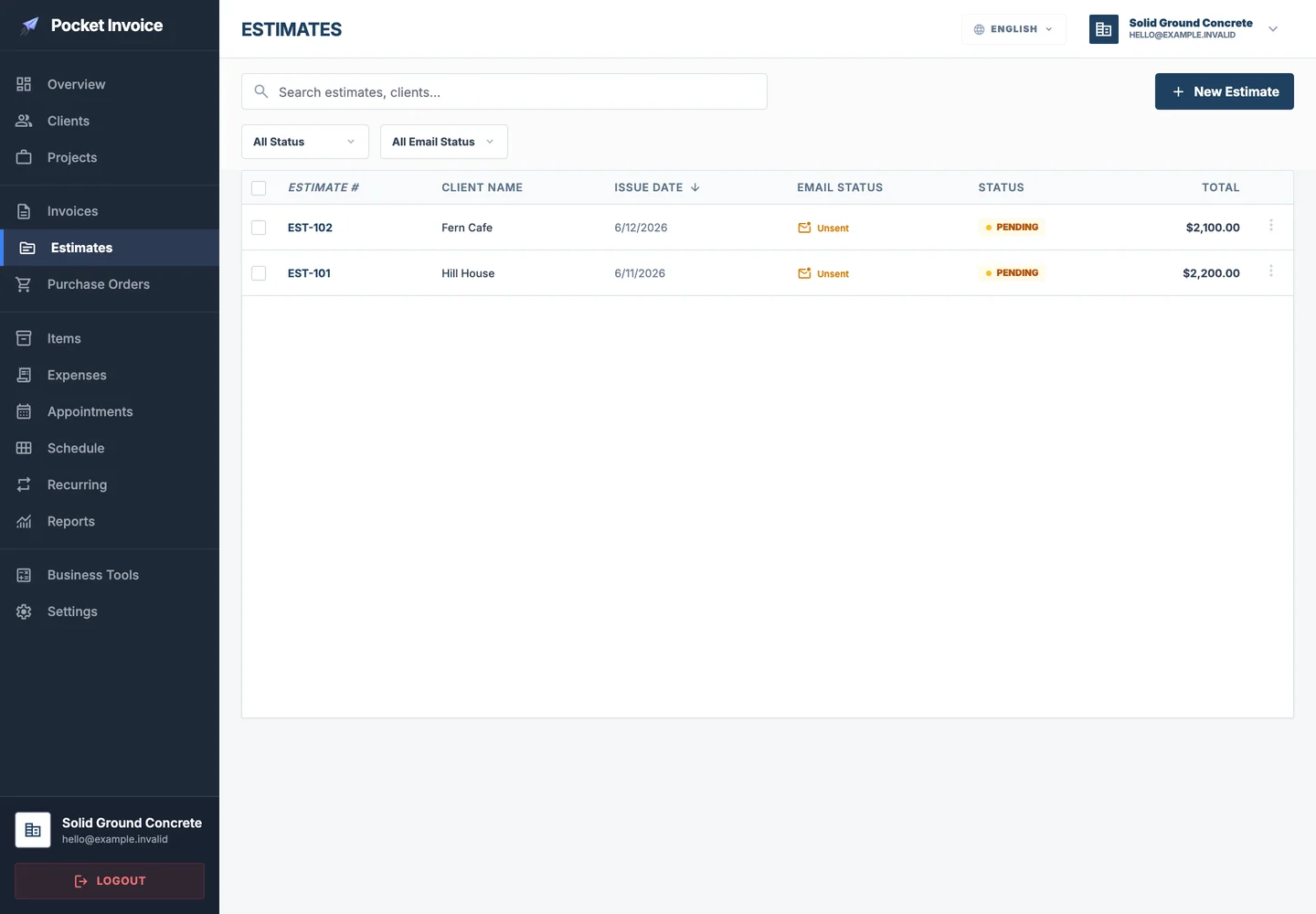
Carry the material quantity into the estimate generator, then describe the work the customer is purchasing. Separate concrete supply, preparation, reinforcement, placing, finishing and additional services where that makes the scope clearer.
- Start directly: prepare an online estimate without creating an account.
- Work on a phone: review the scope and quantities at the site.
- Download a PDF: retain a readable version to share or print.
- Use your identity: add business details, branding and terms.
- Revise before agreement: update quantities and prices, then identify the agreed version.
State delivery access, quote validity, exclusions, schedule, payment stages and the approval method. The calculator does not collect a deposit, signature or payment. Use the actual document and app features available for those steps.
Worked concrete quantity and cost examples
Illustrative calculations, not market quotes. Replace these assumptions with your own costs and measurements.
A rectangular slab from measurement to order
Measure an 18 ft × 12 ft slab at 6 in thick. Convert thickness to 0.5 ft. Net volume = 18 × 12 × 0.5 = 108 ft³ = 4 yd³. With a chosen 10% allowance, adjusted volume = 4.4 yd³ = 118.8 ft³.
At an illustrative ready-mix price of 155 per yd³, material cost = 4.4 × 155 = 682. Using the named bag yields instead would require 264 of the 60 lb bags or 198 of the 80 lb bags. Choose the purchasing method and confirm delivery; these are alternative supply calculations, not quantities to buy together.
Four round footings
Each footing has a 3 ft diameter and 2 ft depth. Radius is 1.5 ft; one volume is π × 1.5² × 2 = 14.137 ft³. Four require 56.549 ft³ = 2.094 yd³ before allowance.
At 5% allowance, total is 59.376 ft³ = 2.199 yd³. Divide by 0.45 or 0.60 and round up: 132 of the 60 lb bags or 99 of the 80 lb bags. Confirm the form dimensions and actual product yield before ordering.
An L-shaped curb and gutter
The curb section is 0.5 ft × 0.5 ft and the adjoining flag is 1.5 ft × 1/3 ft. Combined area = 0.25 + 0.50 = 0.75 ft². For 40 ft of length, net volume = 30 ft³ = 1.111 yd³.
With an illustrative 8% allowance, volume becomes 32.4 ft³ = 1.2 yd³. At 155 per yd³, the material amount is 186. Labor, forms, reinforcement, delivery and tax remain separate. This assumes two non-overlapping rectangular components.
From a 20 × 20 slab to a contractor quote
A 20 ft × 20 ft slab at 4 in thick contains 400 × (4 ÷ 12) = 133.333 ft³ = 4.938 yd³. With 10% allowance, the planned volume is 5.432 yd³. At 155 per yd³, concrete material is about 841.98.
| Illustrative cost | Amount |
|---|---|
| Concrete material | 841.98 |
| Delivery | 100.00 |
| Preparation and reinforcement | 700.00 |
| Labor and equipment | 900.00 |
| Assigned overhead | 200.00 |
| Total cost basis | 2,741.98 |
At 25% markup, the quote before tax is 2,741.98 × 1.25 = 3,427.48, rounded. The margin on that entered basis is 20%. This is a worked budget, not a local market price or a structural thickness recommendation.
Concrete calculator questions
What do M20, M30 and M40 mean?
In the Indian M-grade convention, the number denotes characteristic compressive strength in MPa at the specified 28-day test age: M20 means 20 MPa, M30 means 30 MPa and M40 means 40 MPa. Specimen and testing conventions matter, so do not directly equate these with every other country's strength label. A designer specifies the required grade; a volume or bag calculation does not prove it.
What is an RCC slab?
RCC means reinforced cement concrete: concrete and reinforcement work together to resist the designed actions. Reinforcement, thickness, supports, exposure and detailing affect the design and cost. Estimate volume from the actual drawings and quote steel, formwork and labor separately; one per-square-foot price cannot describe every RCC slab.
How much does a 20 × 20 concrete slab cost?
First specify the thickness. At 4 in, its net volume is about 4.94 yd³; a chosen 10% allowance gives about 5.43 yd³. Multiply the order quantity by a current supplier price, then add preparation, reinforcement, labor, equipment, delivery, overhead and tax as applicable. The worked example above shows the process, not a universal price range.
Does all concrete have a 90-minute placement limit?
No universal timer should replace the project specification. Older ready-mix requirements are often summarized as a 90-minute limit. NRMCA's specification guidance explains that discharge-time or revolution limits may be agreed between contractor and producer to suit conditions. Confirm the applicable specification, mixture, weather and delivery plan with the supplier; do not add water or accept a late load solely on a generic web rule.
How long does a 4-inch slab take to cure?
Thickness alone does not determine readiness. Curing means controlling moisture and temperature so concrete develops its properties; it is not just surface drying. NRMCA describes external curing commonly continuing for 3–7 days subject to the specification, while 28 days is a common strength-test age. Walking, loading and vehicle access require product- and project-specific approval; 24–48 hours is not a universal guarantee of safe use.
How many 80 lb or 60 lb bags make a cubic yard?
Using the named product's approximate yields, 27 ft³ ÷ 0.60 = 45 bags of 80 lb, or 27 ÷ 0.45 = 60 bags of 60 lb, before allowance. Confirm the exact product yield and round the final number upward.
Why not divide concrete weight by bag weight?
The weight estimate uses a placed-concrete density assumption. Bag weight is dry packaged material, while yield states the volume produced after mixing. Bag count should use yield, not those different weight bases.
How much extra concrete should I order?
Use an allowance based on form accuracy, uneven excavation, spillage, placement method and supplier order increments. The editable example is not a universal recommendation. All displayed quantity results already include the entered allowance.
Can I calculate a solid circle with the circular-slabs mode?
Yes. Enter the outside diameter, set the inner diameter to zero, then enter thickness/height and quantity. A ring or tube needs the actual inner diameter. Do not enter a radius into a diameter field.
Does the calculator design foundations or stairs?
No. It calculates the volume of the supported geometry. It does not choose structural dimensions, soil bearing capacity, reinforcement, mix strength, safe loading or code compliance. Use the approved project design.
Explore more free calculators
View all calculators →
Sales tax calculator
Open calculator ↗Service price calculator
Open calculator ↗Profit margin calculator
Open calculator ↗Contractor markup calculator
Open calculator ↗More resources for your business

Business guides
Practical help with estimates, invoices, costs and cash flow.
Explore resource →
Invoice templates
Start with a professional layout for your next document.
Explore resource →
Free document tools
Prepare an itemized invoice or estimate online.
Explore resource →
Help & answers
Find answers about using Pocket Invoice.
Explore resource →Put your numbers into a professional estimate
A calculation is the starting point. Give your customer a clear description of the work, itemized prices and payment terms with Pocket Invoice.
- Build an estimate from your services and materials
- Add your business details, logo and terms
- Preview a PDF before sharing it with your customer
References & further reading
NIST — volume conversions ↗QUIKRETE — Concrete Mix No. 1101 data ↗NRMCA — curing in-place concrete ↗NRMCA — ready-mix specification guidance ↗BIS — concrete standard information ↗
Educational planning tools only. Confirm measurements, prices and applicable tax or lending rules before making a commitment.